Oops! Something went wrong while submitting the form.
X
Contract Manufacturing vs Private Label: What’s the Difference?
Learn the difference between contract manufacturing vs private label, and find which model fits your brand’s goals, quality standards, and growth plans.
If you’re building a wellness or skincare brand, one of the first big calls you’ll make is how to get your product made. Do you go the private label route, or invest in contract manufacturing?
It’s not a small choice.
The global private label market was valued at $915 billion in 2024, showing how many new brands choose speed over customization. Meanwhile, the contract manufacturing industry is on track to surpass $686 billion by the end of 2025, driven by companies that prioritize control, compliance, and product ownership.
Both models are thriving, and both can work depending on where your brand is in its growth journey.
In this article, we will break down the difference between contract manufacturing and private label, how each impacts your speed, cost, and control.
Key Takeaways:
Contract manufacturing offers full control over formulation, testing, and compliance, making it ideal for brands focused on quality and scalability.
Private label allows faster market entry but limits customization, formula ownership, and long-term differentiation.
Brands often start with private label manufacturers to test demand and transition to contract manufacturing as they grow.
Contract manufacturing requires a higher upfront investment but ensures consistency, compliance, and exclusivity.
Respect Manufacturing provides turnkey, CGMP-certified contract manufacturing with complete traceability, testing, and packaging support under one roof.
What Is Contract Manufacturing?
Contract manufacturing is when a brand partners with a specialized production facility to create a product from scratch based on that brand’s own formula, performance requirements, and quality standards.
Unlike private label, where you choose from pre-made options, contract manufacturing gives you full control over formulation, testing, and packaging. You’re not just putting your logo on a bottle; you’re building something uniquely yours with a manufacturer that handles the technical heavy lifting behind it.
For wellness, health, and personal care brands, this model makes it possible to:
Develop custom formulations that align with your claims, ingredients, and target market.
Maintain consistent quality through validated processes and stability testing.
Ensure regulatory compliance since products are made under FDA-registered, CGMP-certified standards.
In short, contract manufacturing lets you own the product and the process without needing your own factory or in-house R&D team.
What You Gain (and Give Up) with Contract Manufacturing
Contract manufacturing helps you move from generic formulas to products that truly represent their identity. But it is not for everyone. Here is what you gain and what you need to be ready for.
Pros of Contract Manufacturing
Full Product Control: You own the formulation, ingredients, and testing standards. Every detail, from texture to packaging, is built to your exact brand vision.
Stronger Quality and Compliance: All production happens under FDA-registered, CGMP-certified systems with documented batch records and testing. That means fewer recalls, fewer surprises, and products retailers can trust.
Scalable Infrastructure: You can grow production without building internal facilities or hiring manufacturing teams. The systems, staff, and equipment already exist, and you simply plug into them.
Exclusive Ownership: Your product is yours alone. The formulation and data are proprietary, protecting your IP and brand differentiation.
Access to Expertise: You gain an experienced R&D and quality team that understands stability, testing, and compliance, which speeds up innovation while minimizing risk.
Cons of Contract Manufacturing
Higher Upfront Costs: Custom development, testing, and documentation require investment. It is a long-term play for brands that want to build, not just launch.
Longer Lead Times: Custom products go through formulation, testing, and validation. Expect months, not weeks, but it ensures consistency and compliance.
Regulatory Involvement: Compliance adds paperwork. Your manufacturer handles most of it, but your internal team must stay aligned for audits and labeling accuracy.
Higher Minimums: Many facilities set larger production minimums to keep efficiency high. It is best suited for brands with validated demand or clear growth plans.
Contract manufacturing demands planning and patience, but in return, you gain something far more valuable: a product that is fully yours, built to last, and ready to scale.
What Is Private Label Manufacturing?
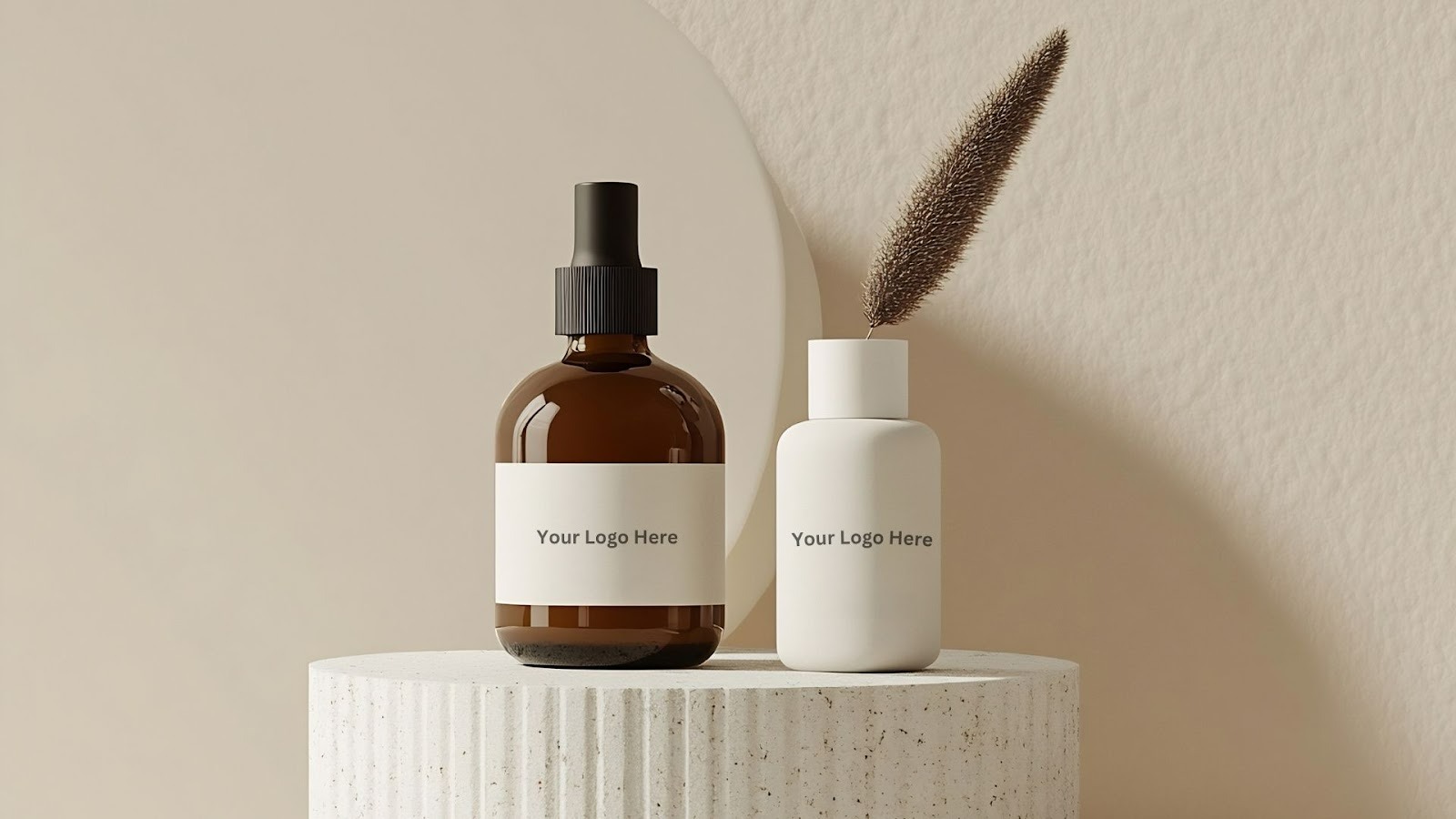
Private label manufacturing lets brands launch products quickly using pre-formulated, market-tested options that the manufacturer already owns. You choose an existing formula, customize the packaging, labeling, and design, and sell it under your brand name.
It is a popular choice for new skincare, wellness, and personal care brands because it eliminates the need for R&D or complex formulation work. Since these products are already tested and compliant, you can move from concept to shelf in a matter of weeks.
For example, a new skincare brand might select a ready-made “Vitamin C Serum,” customize the bottle design and brand visuals, and bring it to market as its own. The formulation stays the same, but the packaging and brand identity make it unique.
What You Gain (and Give Up) with Private Label
Private label manufacturing makes it easy for new brands to get to market fast. It is a straightforward way to launch quickly, but it also limits how much control you have over your product and its performance.
Here are the advantages and limitations of private label manufacturing.
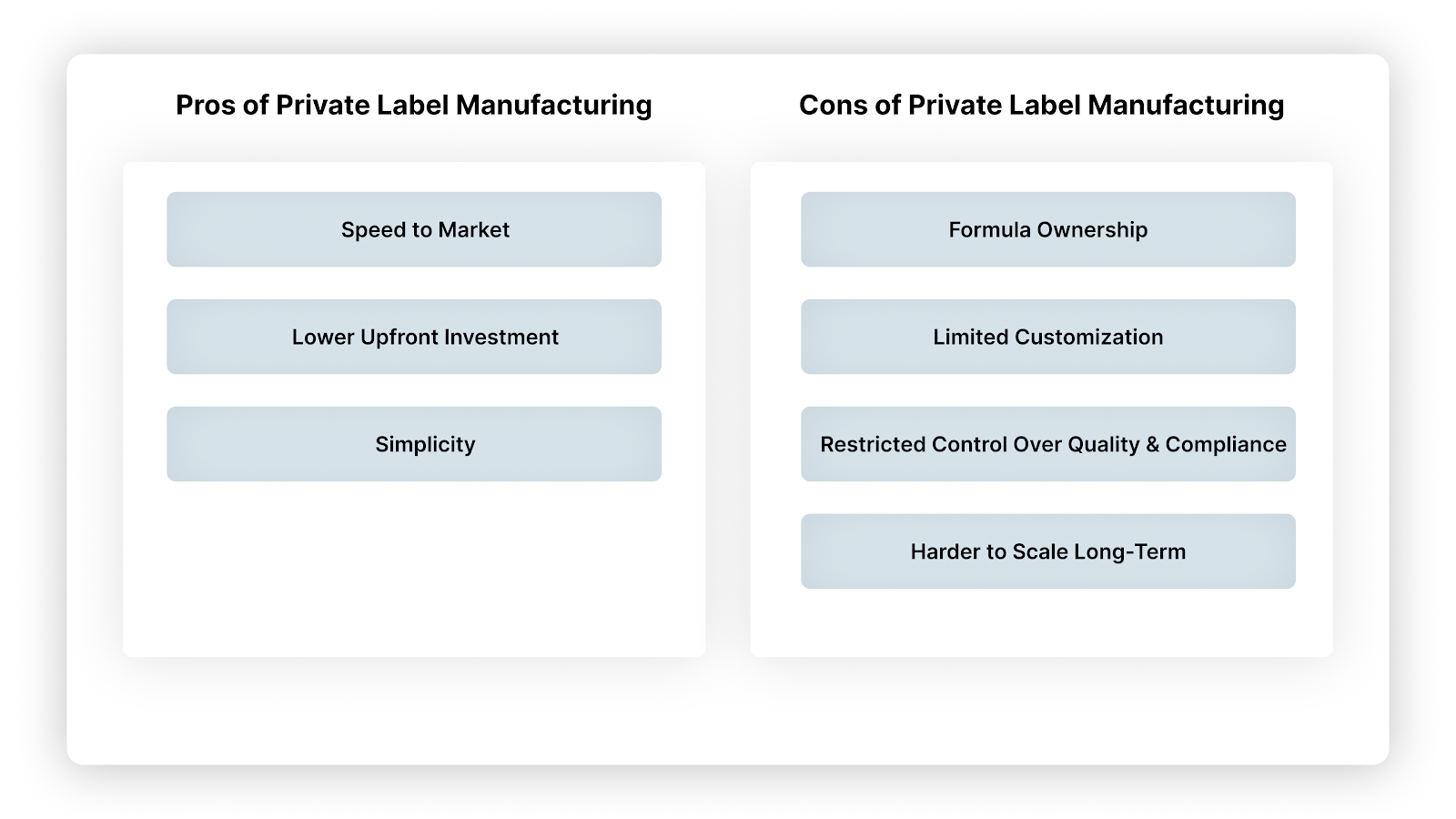
Pros of Private Label Manufacturing
Speed to Market: Products are already formulated, stability-tested, and ready for production. This allows you to launch within weeks rather than months.
Lower Upfront Investment: There are no R&D or testing costs, making it easier to start small and test market demand before committing to large volumes.
Simplicity: The manufacturer handles formulation, production, and packaging, allowing founders to focus on branding and sales instead of operations.
Cons of Private Label Manufacturing
Formula Ownership: You do not own the formula. The same product may be available to multiple brands under different labels, which makes differentiation difficult.
Limited Customization: Adjustments to ingredients, concentrations, or performance are rarely possible. You can change packaging or fragrance, but not the product itself.
Restricted Control Over Quality and Compliance: Because the product is pre-made, you have little influence over sourcing, testing, or documentation. This can become a challenge when expanding into new markets or retailers with stricter standards.
Harder to Scale Long-Term: Private label is designed for speed, not longevity. As your brand grows, you may need to transition to contract manufacturing to achieve the consistency, compliance, and exclusivity that larger retailers and global markets demand.
Private label is ideal for brands testing new markets or launching quickly with minimal risk. As your brand matures, transitioning to contract manufacturing gives you greater control, exclusivity, and scalability.
Contract Manufacturing vs Private Label: A Side-by-Side Comparison
Every founder eventually faces the same question: what matters most right now, speed or control?
Private label helps you launch quickly and test market response, while contract manufacturing supports brands ready to customize, scale, and build proprietary products.
Here is how the two models compare:
Aspect
Contract Manufacturing
Private Label
Formula Ownership
The brand owns or co-owns the formula and full product data.
The manufacturer owns the formula and can sell it to multiple brands.
Customization Level
Fully customizable. Every ingredient, concentration, and packaging detail can be tailored to your needs.
Limited customization. Only branding, scent, or packaging can typically be changed.
R&D and Testing
Full access to R&D, stability testing, and performance validation.
No R&D involvement. The formula is pre-tested and pre-approved.
Compliance and Documentation
Built under CGMP and FDA-registered systems, with traceable batch records.
Compliance documentation is standardized and may not cover unique claims or markets.
Quality Control
End-to-end oversight on sourcing, testing, and batch consistency.
Quality managed by the manufacturer with limited visibility for the brand.
Upfront Investment
Higher initial setup for formulation and testing, but lower long-term cost per unit.
Lower startup cost but higher per-unit pricing as you scale.
Time to Market
Longer development period (typically 3–6 months) to ensure quality and compliance.
Shorter launch timelines (often 4–8 weeks).
Scalability
Designed for long-term growth, consistent performance, and brand exclusivity.
Best for early-stage testing or small product lines.
Ideal For
Established or scaling brands focused on quality, control, and compliance.
Startups testing market demand with limited resources.
Both models can help you bring a high-quality product to market. Private label is ideal for quick launches and early-stage testing, while contract manufacturing offers more customization, scalability, and ownership once your brand is ready to expand.
Choosing the Right Model for Your Brand
Both models can take your product to market, but the right choice depends on your goals, resources, and how much control you want over the end product.
Private label is built for speed and simplicity. It works best when you are testing a new concept, validating demand, or entering the market with limited capital. You can start small, move quickly, and refine your brand positioning before committing to full-scale production.
Contract manufacturing is built for customization and scalability. It suits brands that want control over raw materials, testing, packaging, and compliance. While it requires more time and upfront investment, it offers long-term consistency and flexibility across product lines and markets.
Here is how to decide what fits your current stage:
If you are
Start with
Then transition to
Launching your first product and testing the market
Private label
Contract manufacturing once demand stabilizes
Expanding an existing product line or entering retail
Contract manufacturing
—
Focused on product differentiation and compliance
Contract manufacturing
—
Working with limited budgets and short timelines
Private label
Contract manufacturing as you scale
Both models serve different stages of growth. Many brands begin with private label to validate demand, then shift toward contract manufacturing as they expand into new markets and product categories. The key is choosing a partner that supports both paths so your transition is seamless when the time comes.
Why Growing Brands Choose Respect Manufacturing
As skincare and wellness brands grow, their production needs often become more complex. Maintaining consistent quality, meeting compliance standards, and managing multiple vendors can slow down even the strongest teams. Without a structured system, it becomes difficult to scale efficiently and maintain visibility across formulation, packaging, and testing.
Respect Manufacturing solves these challenges with a turnkey, CGMP-certified model designed for flexibility, precision, and transparency. Whether you need a ready-to-launch private label solution or fully custom contract manufacturing, every stage is managed under one roof to ensure quality, speed, and compliance.
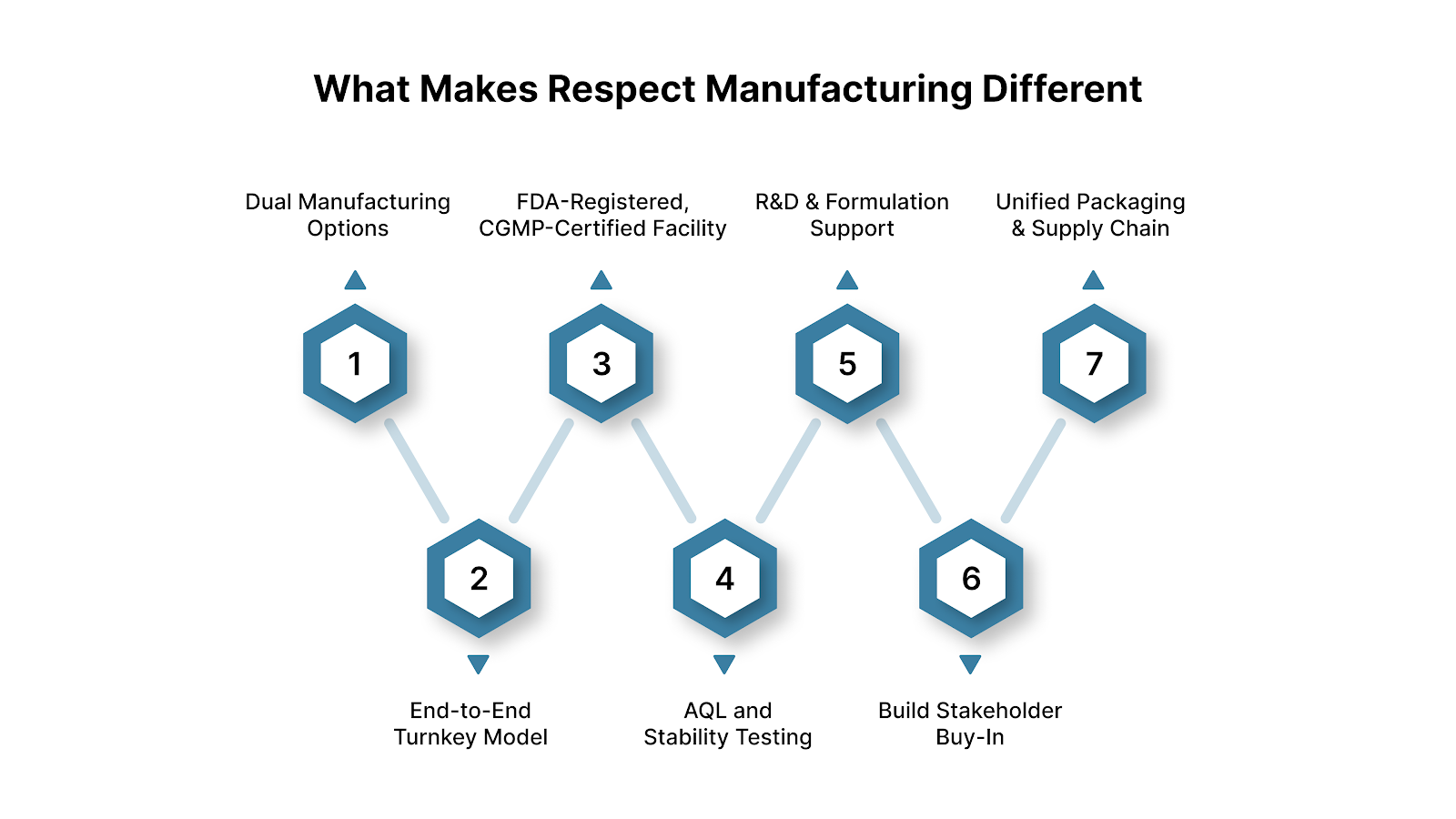
What Makes Respect Manufacturing Different
Dual Manufacturing Options: Choose between private label for fast market entry or contract manufacturing for custom, scalable formulations.
End-to-End Turnkey Model: Manages everything from formulation, testing, and manufacturing to packaging, logistics, and compliance, eliminating the need for multiple vendors.
FDA-Registered, CGMP-Certified Facility: All products are manufactured in a modern facility with stainless steel automated production lines, ensuring safety, consistency, and reliability.
AQL and Stability Testing: Conducts inbound and outbound Acceptance Quality Limit (AQL) testing and full stability testing to verify quality and shelf life.
Collaborative R&D and Formulation Support: Partners closely with brands to develop or refine formulas that meet performance, market, and compliance goals.
Transparent and Traceable Operations: Every step of production is documented and auditable, ensuring full regulatory alignment and accountability.
Integrated Packaging and Supply Chain: Through its partnership with CDW, Inc., Respect handles packaging design, sourcing, decorating, and finishing, delivering fully retail-ready products.
Respect Manufacturing provides the structure, quality systems, and flexibility you need, whether you are launching fast or scaling for the long term.
Conclusion
Choosing between contract manufacturing and private label comes down to where your brand is today and where you want to go next. Private label helps you launch quickly and test demand, while contract manufacturing gives you full control when you are ready to scale.
Respect Manufacturing supports both paths. As a CGMP-certified, FDA-registered partner, we manage everything from formulation and testing to packaging and logistics under one roof. Every product is built for consistency, compliance, and market readiness.
Build your brand with a partner that offers flexibility, precision, and transparency.Partner with Respect Manufacturingto bring your product to market with confidence.
FAQs
1. What are the disadvantages of contract manufacturing for a company?
Higher upfront costs, longer timelines, and detailed compliance requirements, but it ensures stronger quality control and long-term scalability.
2. What is the difference between CDMO and private label?
A CDMO (Contract Development and Manufacturing Organization) develops and manufactures custom formulas. Private label offers pre-made products for quick branding and faster market entry.
3. What is the difference between a private label and a manufacturer brand?
Private label products are made by one company and sold under another’s brand. Manufacturer brands own and market their own products.
4. What is the difference between a co-manufacturer and a private label?
A co-manufacturer customizes production for your formula. Private label uses ready-made formulations for faster, lower-cost launches.
Get in touch
Thank you! Your submission has been received!
Oops! Something went wrong while submitting the form.
Trusted by 100+ Growth Leaders.
Related blogs
8 min read
How To Start Your Own Hair Product Line In The USA: A Complete Operational Guide For 2026
How to start your own hair product line in the USA with a step-by-step operational guide covering R&D, MoCRA compliance, packaging, and turnkey manufacturing.
Explore FDA packaging labeling requirements for food, including ingredient declarations, allergen labeling, and compliance strategies to meet FDA standards.