Oops! Something went wrong while submitting the form.
X
Guidelines for FDA Cosmetics Compliance
Secure your cosmetic brand's success. Follow FDA Cosmetics Guidelines for safety, labeling, and MoCRA compliance. Stay ahead with timely updates. Act now!
Have you ever worried about whether your cosmetic products meet all the FDA requirements?
Many beauty founders feel confident about their formulas until they reach the compliance stage and realise how much documentation, labelling, and testing are actually required.
And the stakes are real. The beauty and personal care industry is booming, it’s worth $646.20 billion in 2024 and expected to reach $677.2 billion in 2025. With a steady3.33%annual growth rate forecasted through 2028, demand is rising fast, and so is FDA scrutiny.
With the FDA tightening rules under MoCRA, having a great formula isn’t enough anymore. Brands must ensure proper safety testing, accurate labeling, solid manufacturing records, and clear ingredient reporting to stay compliant.
In this article, we’ll learn exactly what the FDA expects from cosmetic brands today, from ingredient rules and labeling essentials to GMP standards, documentation, and testing requirements, all explained in clear, founder-friendly terms.
Need to Know
FDA cosmetic compliance is mandatory under MoCRA, not optional.
Product safety, accurate labeling, and ingredient transparency form the core of compliance.
Drug-like claims can immediately shift your product into drug classification — avoid them.
CGMP manufacturing, stability testing, and detailed documentation are essential for launch readiness.
Brands must register facilities, list products with the FDA, and maintain 6-year records.
Marketing, influencer content, and e-commerce listings must align with FDA cosmetic guidelines.
A reliable manufacturing partner can significantly reduce compliance risks and production delays.
Understanding the FDA’s Role in the Beauty Industry
The FDA oversees the safety and integrity of cosmetic products sold in the United States. While the agency doesn’t approve cosmetics before they hit the market, it does enforce strict rules to ensure products are safe, properly labeled, and manufactured under reliable quality standards.
Here’s what the FDA is responsible for:
Ensuring product safety: The FDA requires cosmetics to be safe for their intended use and free from harmful contamination.
Overseeing accurate labeling: All cosmetic labels must follow FDA guidelines, including ingredient lists, warnings, and proper identity statements.
Setting Good Manufacturing Practice (GMP) expectations: Manufacturers must follow quality processes that reduce risks of contamination, mislabeling, and product inconsistencies.
Monitoring ingredient compliance: The FDA restricts or bans certain ingredients and ensures brands disclose all components using proper INCI names.
Enforcing MoCRA regulations: Under the Modernization of Cosmetics Regulation Act, brands must follow new rules for safety substantiation, facility registration, and product listing.
Taking action against non-compliant products: The FDA can issue warnings, mandate recalls, or take legal action if products are unsafe or mislabeled.
With a clear picture of how the FDA oversees cosmetics, it’s time to look at the exact rules and requirements every beauty brand must follow.
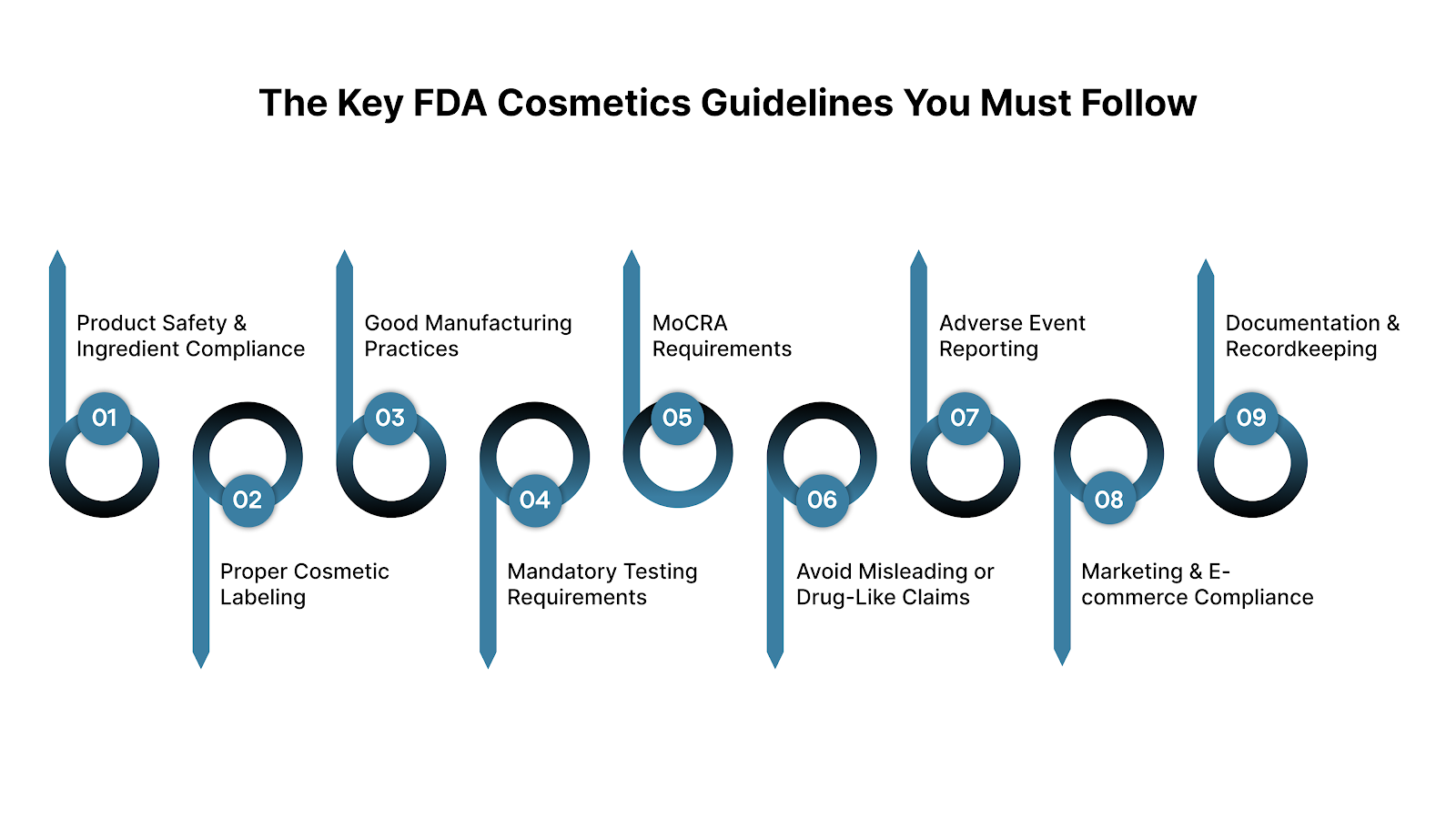
The Key FDA Cosmetics Guidelines You Must Follow
To legally sell cosmetics in the United States, your products must meet a set of FDA requirements designed to protect consumer safety and ensure transparent labeling. These rules aren’t optional, they apply to every beauty brand, whether you're launching a single product or scaling a full cosmetics line.
Here are the essential guidelines you need to understand:
1. Product Safety & Ingredient Compliance
Your cosmetic must be safe for consumer use under labeled or customary conditions.
Key requirements:
Ingredients must be safe and used within accepted limits.
Prohibited and restricted ingredients must be avoided or carefully regulated.
Claims must be truthful. If you make drug-like claims (“treats acne,” “heals skin”), your product may be regulated as a drug, not a cosmetic.
Documentation of safety substantiation is required under MoCRA.
2. Proper Cosmetic Labeling
The FDA requires accurate, transparent, and compliant labels on all cosmetic products. Your label must include:
Identity of the product (e.g., “liquid eyeliner”).
Net quantity of contents in both U.S. and metric units.
Ingredient list in correct INCI naming format, listed in descending order.
Name and business address of the manufacturer or distributor.
Required warnings for specific categories (eye products, flammable items, etc.).
Clear separation between cosmetic labels and drug labels for hybrid products.
3. Good Manufacturing Practices (GMP)
While historically voluntary, GMP is now becoming essential under MoCRA.
Brands should ensure:
Products are manufactured in a clean, controlled facility.
Written procedures are followed for batching, filling, and labeling.
Equipment is sanitized and documented properly.
Lot numbers, batch records, and traceability systems are in place.
Staff are trained on quality processes.
Partnering with a CGMP-certified, FDA-registered facility like Respect Manufacturing helps to remove much of the operational risk.
4. Mandatory Testing Requirements
The FDA expects brands to have documented evidence of product safety. Your manufacturer should conduct:
Stability Testing: Confirms shelf life, texture, and performance over time.
Microbiological Testing: Ensures the product is free from harmful microorganisms.
Preservative Efficacy (PET) Testing: Verifies the formula remains safe after opening.
Packaging Compatibility Testing: Ensures formula and packaging work together safely.
5. MoCRA Requirements (Effective 2024–2025)
The Modernization of Cosmetics Regulation Act (MoCRA) introduces new compliance requirements for brands, including:
Mandatory facility registration with the FDA.
Product listing for each SKU sold in the U.S.
Responsible Person designated for safety documentation.
Adverse event reporting within 15 business days.
Annual updates on manufacturing or formulation changes.
Record-keeping requirements for at least 3 years.
Under MoCRA, compliance is no longer negotiable; it’s legally required.
6. Avoid Misleading or Drug-Like Claims
One of the most important FDA cosmetic rules is avoiding claims that make your product sound like a drug. Cosmetics can enhance appearance, but they cannot claim to treat, cure, heal, or alter body functions. To stay compliant, avoid claims such as:
“Treats acne”
“Repairs skin barrier”
“Heals eczema or dermatitis”
“Eliminates dark spots permanently”
“Stimulates collagen production”
Instead, use cosmetic-appropriate language like:
“Helps reduce the appearance of redness”
“Visibly brightens skin”
“Improves the look of dark spots over time”
“Leaves skin feeling smoother and more hydrated”
7. Adverse Event Reporting
Before selling cosmetics, brands must have a system for tracking complaints and reporting serious issues. Under MoCRA, adverse event reporting is now mandatory, and poor recordkeeping can trigger regulatory action.
Track and document all consumer complaints.
Report serious adverse events to the FDA within required timelines.
Maintain records for 6 years (MoCRA requirement).
Keep clear procedures for handling and investigating complaints.
8. Marketing & E-commerce Compliance
Your marketing must be just as compliant as your product. Any claims, on websites, social media, or influencer posts must align with FDA cosmetic rules and avoid implying drug-like benefits.
Ensure all website/product descriptions match label claims.
Keep digital marketing aligned with FDA claim guidelines.
Avoid before/after images that imply therapeutic effects.
Ensure influencer content stays within compliant claim limits.
9. Documentation & Recordkeeping
MoCRA requires stronger documentation than ever. Brands must maintain detailed records for safety, manufacturing, and compliance, ready for inspection at any time.
Maintain up-to-date SOPs, safety files, test reports, and batch records.
Keep ingredient supplier documents, COAs, and SDS files organized.
Store all compliance documentation for 6 years as required under MoCRA.
Prepare for potential FDA inspections or audits at any time.
Now that you’ve covered the core compliance checklist, here are additional expert tips that can further strengthen your FDA readiness.
Expert Tips to Stay Fully FDA-Compliant
Beyond the core FDA requirements, these additional practices can help beauty brands stay proactive, organized, and audit-ready:
Keep Updated Safety Files: Maintain a central folder for SDS, allergen statements, COAs, and toxicology reports so they’re always ready for review.
Review Claims Every Quarter: Marketing teams often update website copy or ads, schedule periodic claim audits to prevent accidental drug-like language.
Document Every Change: Whether it’s switching suppliers, adjusting formulations, or updating packaging, record each change to maintain a clean compliance trail.
Train Your Team on MoCRA Basics: Short internal workshops can help product, marketing, and customer service teams avoid compliance mistakes.
Monitor High-Risk Ingredients: Watch for restricted or commonly flagged ingredients like hydroquinone, retinol derivatives, color additives, or strong preservatives.
Stay Aware of State-Level Rules: States like California (Prop 65) and New York have additional ingredient reporting laws beyond federal guidelines.
Work with Certified Labs: Using reputable testing labs for stability, microbiology, and safety assessments reduces the risk of FDA objections.
Quick FDA Cosmetics Compliance Checklist for Beauty Founders
Use this simple list as a final readiness check before taking any cosmetic product to market. This high-level checklist helps founders stay aligned with the core FDA and MoCRA requirements without getting overwhelmed.
Make sure every product has documented safety substantiation.
Verify all ingredients are allowed, correctly labeled, and fully disclosed.
Confirm your manufacturer follows CGMP and maintains batch-level records.
Check that your labels include all required FDA elements (identity, net qty, ingredients, warnings, responsible person).
Review all marketing and product claims to avoid drug-like wording.
Submit product listings to the FDA and update them when formulas change.
Maintain 6-year records of complaints, adverse events, and product documentation.
Monitor customer feedback and report any serious adverse events as required.
Now that you know what FDA compliance requires, the next challenge is finding a manufacturing partner who can actually support you through every step, without slowing down your launch timelines.
For many beauty founders, the real challenge begins after formulation. CGMP requirements, stability testing, labeling rules, and documentation can quickly become overwhelming, and coordinating multiple vendors often creates even more gaps and delays.
Respect Manufacturing simplifies the entire process with a fully compliant, end-to-end ecosystem.
Key Features You Get With Respect Manufacturing
FDA-registered, CGMP-compliant facility with automated stainless steel production lines
Full formulation support, including new product development and refinement
AQL testing on all incoming raw materials and packaging components
Stability testing to validate shelf life and product performance
Comprehensive documentation for audits, product listings, and regulatory filings
Flexible packaging formats, from bottles and jars to tubes, sachets, and stickpacks
Turnkey solutions, from concept to finished goods, eliminating multi-vendor complexity
With Respect Manufacturing, beauty brands gain a single, reliable partner that strengthens compliance, speeds up production, and delivers market-ready products with total confidence.
Final Thoughts
FDA compliance goes beyond legal obligation; it’s what protects your brand’s credibility and supports long-term growth. With the right systems and the right manufacturing partner, compliance becomes simpler, faster, and far less stressful.
If you’re ready to create or scale cosmetic products with confidence,Respect Manufacturing offers the expertise, infrastructure, and end-to-end support you need to stay compliant and competitive in today’s rapidly evolving beauty market.Connect with Respect Manufacturing.
FAQs
1. Does the FDA approve cosmetic products before they go to market?
No. The FDA does not pre-approve cosmetic products, but brands are responsible for ensuring safety, accurate labeling, and compliance with MoCRA regulations before selling.
2. What makes a cosmetic claim “drug-like”?
Any claim that suggests treatment, prevention, or alteration of a medical condition, such as “treats acne,” “heals eczema,” or “reduces inflammation”, is considered drug-like and requires drug-level approval.
3. What documentation should beauty brands keep for FDA compliance?
Brands must keep safety substantiation, stability test results, batch records, adverse event logs, supplier documentation, and product listing information for at least six years.
4. Do imported cosmetic products need to meet FDA guidelines?
Yes. Imported cosmetics must meet the same safety, labeling, ingredient, and manufacturing requirements as U.S.-made products. The overseas manufacturer also needs proper documentation.
5. What happens if the FDA finds a compliance issue in a cosmetic product?
The FDA may issue a warning letter, enforce product recalls, mandate labeling changes, or require corrective actions. Serious violations can result in product seizures or injunctions.
Get in touch
Thank you! Your submission has been received!
Oops! Something went wrong while submitting the form.
Trusted by 100+ Growth Leaders.
Related blogs
8 min read
How To Start Your Own Hair Product Line In The USA: A Complete Operational Guide For 2026
How to start your own hair product line in the USA with a step-by-step operational guide covering R&D, MoCRA compliance, packaging, and turnkey manufacturing.
Explore FDA packaging labeling requirements for food, including ingredient declarations, allergen labeling, and compliance strategies to meet FDA standards.