Schedule a Call
Ready to Upgrade Your Process Operations?
Ready to Upgrade Your Process Operations?
Explore the complete skincare product development process in 10 steps and learn how top brands turn ideas into safe, effective market-ready products.
If you have ever tried to turn a skincare idea into a real product, you already know the hard part is not inspiration; it is execution. Between formulation challenges, compliance checks, and endless rounds of testing, even simple projects can stall for months without a clear roadmap.
That is why understanding the full skincare product development process matters.
Each step, from market research to stability testing, plays a role in ensuring your product is safe, effective, and built to last once it hits the shelf.
In this article, we will walk through the key stages of skincare product development, common pitfalls to avoid, and what it takes to move from idea to market-ready product with confidence.
Key Takeaways:
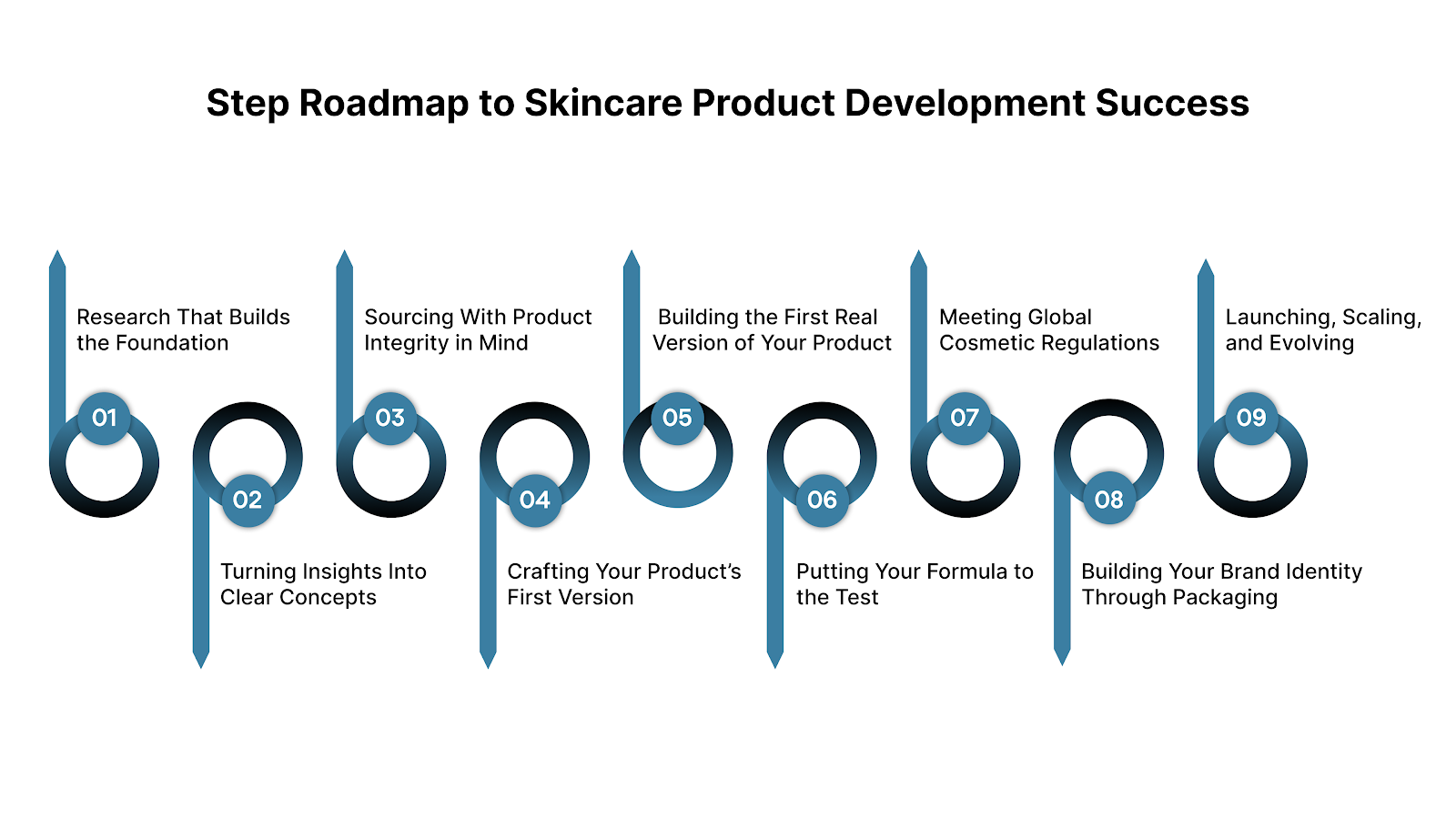
Below are the ten essential stages every skincare product goes through, from early research to market launch. Each step builds on the last to ensure your formula is safe, compliant, and ready to perform in real-world conditions.
Before you start formulating, take a step back and look at the market.
This is where most skincare projects succeed or fall short — not in the lab, but in understanding what people actually want and what already exists.
You might have a great product idea, but first, ask yourself:
What You’re Solving For:
Understand your customer and identify the gap your product can genuinely fill.
What To Focus On:
What You’ll Get Out of It:
A clear unique selling proposition (USP) and a grounded product concept that balances market demand with scientific feasibility.
This is where your idea starts taking shape. However, too many brands skip this stage and jump straight into formulation. The result is confusion between teams, mixed messaging, and a product that never quite delivers what it promises.
What You’re Solving For:
What To Focus On:
What You’ll Get Out of It:
A clear product blueprint that links your concept to real-world execution with formulation goals, packaging direction, and performance expectations all aligned.
This stage is about ensuring every ingredient in your formula is safe, compliant, and fits your performance goals.
What You’re Solving For:
Select ingredients based on proven efficacy, safety data, and compliance with cosmetic regulations.
What To Focus On:
What You’ll Get Out of It:
A verified list of ingredients that not only supports your product’s claims but also meets regulatory, safety, and sustainability standards.
At this stage, you begin developing lab samples that turn your claims and research into something tangible, a formula that performs the way you envisioned.
What You’re Solving For:
Develop a formulation that delivers the benefits you’ve promised while remaining safe, stable, and compliant with cosmetic regulations.
What To Focus On:
What You’ll Get Out of It:
A working lab sample that meets your product’s safety, performance, and compliance goals. It is the foundation for all future testing and refinement.
Your prototype should be as close as possible to your intended final product. This is the version you will test, evaluate, and refine before scaling up production.
What You’re Solving For:
Develop a working prototype that mirrors the look, feel, and performance of the finished product.
What To Focus On:
What You’ll Get Out of It:
A functional prototype that closely replicates the final product, ready for stability, safety, and efficacy testing.
Prototyping helps you catch potential issues before production, which in turn helps save time, resources, and costly rework later.
Testing ensures your formula is not only effective but also safe, compliant, and suitable for the target skin type. Though it can feel like a lengthy phase, testing is the backbone of product credibility. A well-tested product builds consumer trust, supports brand reputation, and reduces the risk of costly recalls or complaints later on.
What You’re Solving For:
Validate that your product performs as promised and meets all safety and regulatory standards.
What To Focus On:
What You’ll Get Out of It:
A validated formula that has passed essential safety, stability, and performance tests, confirming that it’s ready for production and market launch.
Before your product reaches shelves, it must meet all relevant safety and labeling regulations. This step ensures your formula, packaging, and marketing claims comply with global cosmetic standards.
What You’re Solving For:
Confirm that your product meets regulatory requirements and that all claims are accurate and substantiated.
What To Focus On:
What You’ll Get Out of It:
A fully compliant product that meets FDA or other international standards and is ready for retail or export approval.
Your packaging is more than just a container — it is part of the product experience. At this stage, the goal is to design packaging that reflects your brand identity while protecting the integrity of your formula.
What You’re Solving For:
Create packaging that aligns with your brand’s aesthetic and maintains the safety and stability of your product.
What To Focus On:
What You’ll Get Out of It:
An appealing, compliant, and functional package that protects your product and strengthens your brand presence on the shelf or online.
Once your product is finalized and packaged, it is time to prepare for launch, and that begins with scaling up production.
Scaling bridges lab success with manufacturing reality. It ensures your formula performs consistently at higher volumes and across multiple batches. This process often involves fine-tuning mixing times, temperature control, and filling systems to replicate your prototype’s texture and stability at scale.
After successful scale-up, your product is ready for market rollout, but the work does not stop there. A strong launch combines marketing, quality tracking, and continuous improvement.
What You’re Solving For:
Execute a launch that maintains consistency from lab to line while keeping oversight of product performance after release.
What To Focus On:
What You’ll Get Out of It:
A smooth scale-to-launch transition with verified product consistency, strong market entry, and the insights needed to improve future releases.
If you have made it this far, you already know skincare product development takes a team. Chemists, quality leads, packaging experts, and compliance specialists all need to work in sync toward a single goal.
Without that structure, even the most promising concept can stall. Many brands struggle to scale from lab success to consistent, compliant batches. Timelines slip, quality fluctuates, and coordinating multiple vendors adds unnecessary risk.
For a growing brand, staying connected across formulation, testing, packaging, and compliance is what separates a smooth launch from an expensive delay.
That is exactly the kind of system the right manufacturing partner provides.
As a CGMP-certified, FDA-registered contract manufacturer, Respect Manufacturing streamlines the entire product journey under one roof. From R&D to full-scale production, every stage is managed with precision, transparency, and regulatory confidence.
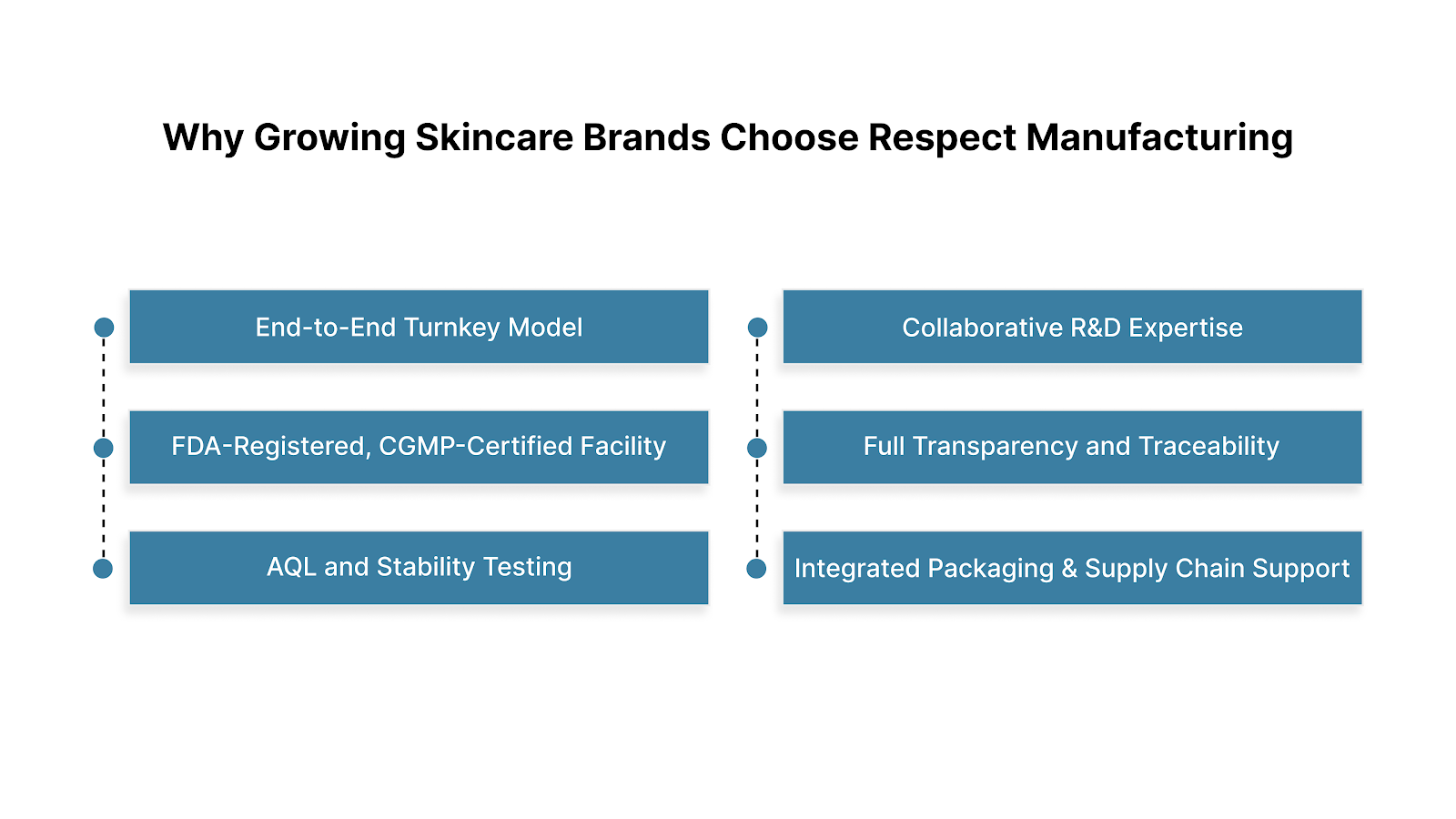
What sets us apart:
At Respect Manufacturing, quality, compliance, and innovation are not optional — they are built into every batch. That is how growing skincare and wellness brands bring their ideas to life faster, safer, and with complete confidence.
Skincare product development demands both creativity and control. From research and formulation to testing and compliance, each stage must align seamlessly to bring a safe, effective product to market. The brands that succeed are the ones that treat development as a disciplined process built on consistency and precision.
That is where Respect Manufacturing comes in.
As a CGMP-certified, FDA-registered partner, Respect unites formulation, testing, packaging, and compliance under one roof. With transparent systems and collaborative R&D, you get products that meet market demand and regulatory standards without delay.
Partner with Respect Manufacturing to turn your skincare concept into a compliant, scalable, and market-ready product.
Learn cosmetic science, formulation, and compliance. Gain lab or manufacturing experience to understand ingredients, safety testing, and regulatory standards in skincare creation.
It’s the process of researching, formulating, testing, and packaging skincare products to meet performance, safety, and regulatory standards before market launch.
Ingredients above 1% are listed in descending order of concentration. Those below 1% can appear in any order but must still be disclosed.
The seven stages include idea generation, concept creation, formulation, prototyping, testing, packaging, and product launch. Each ensures quality and compliance before market release.