Oops! Something went wrong while submitting the form.
X
How to Start a Makeup Line: A Step-by-Step Guide
Learn how to start a makeup line from concept to launch with expert tips on formulation, packaging, and compliance. Build your beauty brand the right way.
Have you ever looked at your favorite makeup brand and thought, “I could create something like that, maybe even better?”
But you’re stuck wondering how to actually make your makeup line real. How do you find the right formulas? Who ensures your products are safe and compliant? And how do you go from “concept” to “shelf-ready” without getting lost in endless testing, suppliers, and delays?
If that sounds familiar, you’re not alone. Many aspiring beauty founders hit this wall, passionate about creating great products, but overwhelmed by the technical side of manufacturing and regulations.
Yet the opportunity has never been greater. According to McKinsey & Company’s “State of Beauty 2025” report, the global beauty industry is expected to surpass$580 billion by 2027, growing at around 7% annually. Meanwhile, the color cosmetics category (foundations, lipsticks, and eyeshadows) is projected to grow at a7.2 % CAGR between 2025 and 2034.
That’s a massive opportunity, but only for brands that build with the right foundations: smart planning, reliable manufacturing, and airtight compliance.
In this article, you’ll learn exactly how to start your own makeup line, from finding your niche and crafting your business plan to partnering with a CGMP-certified manufacturer and scaling a brand that customers love.
At a Glance
The global beauty industry is booming, offering massive potential for new brands.
Success in starting a makeup line depends on careful planning, regulatory compliance, and strong manufacturing partnerships.
You’ll need to define your niche, create a business plan, and develop your product concept strategically.
Partnering with a CGMP-certified manufacturer can streamline your journey from idea to finished product.
Expect initial startup costs to range between $10,000 and $200,000, depending on your scale and formulations.
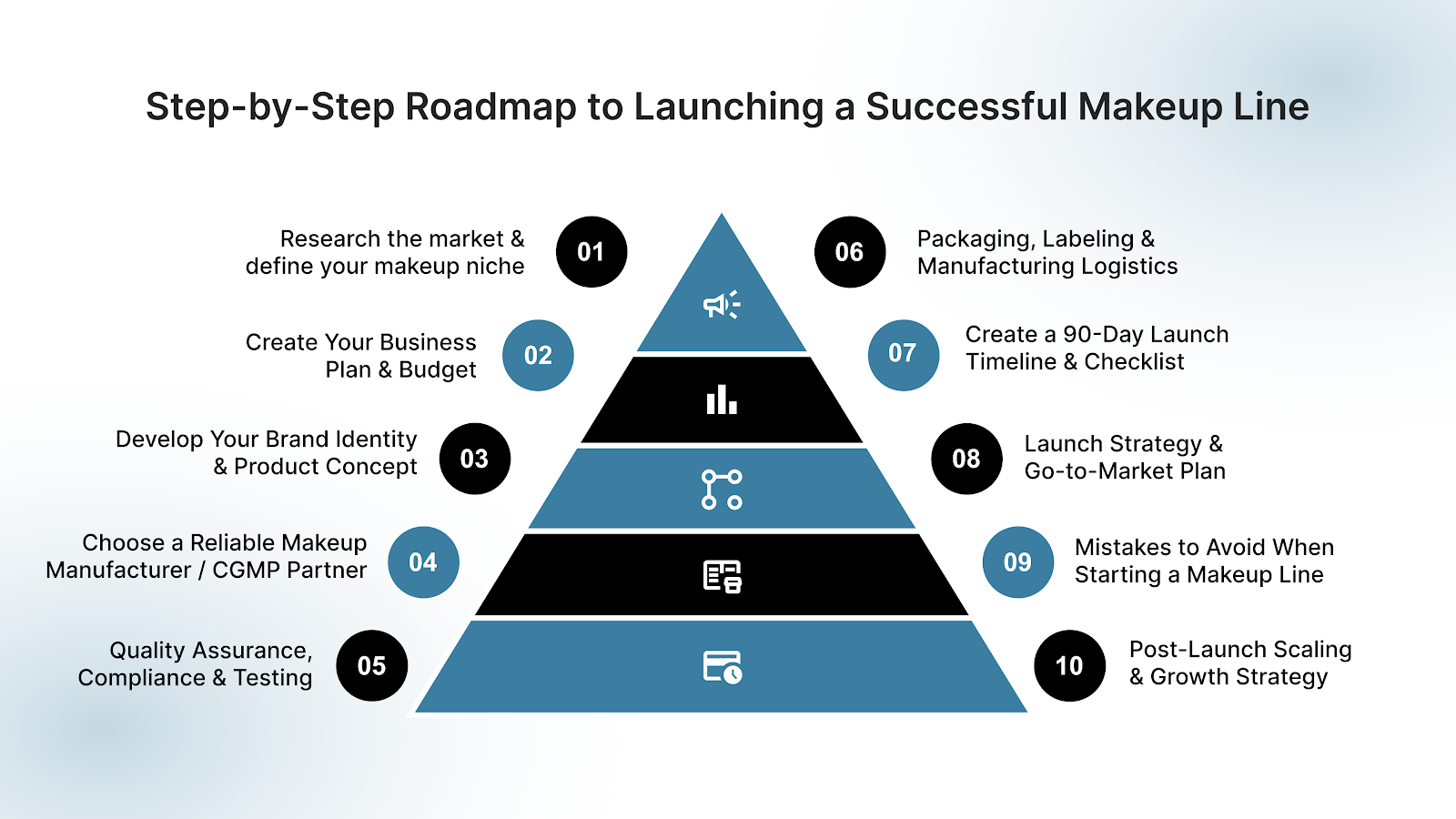
Step-by-Step Roadmap to Launching a Successful Makeup Line
Did you know the global beauty market grew by roughly 10% in 2023, and though future growth is forecasted at around5% annually through 2030, that still signals a meaningful opportunity for new brands that are smart about planning and execution?
Here’s how to do it, step by step.
Step 1. Research the Market & Identify Your Makeup-Line Niche
Before you design your first product or choose a shade name, you need to understand who you’re creating for.
Market research helps you position your brand strategically instead of guessing what will sell. It prevents costly missteps and ensures your line resonates with your ideal customer. According to the Business of Fashion x McKinsey “State of Fashion: Beauty 2024” report, 63% of consumers don’t believe premium beauty brands perform better than affordable ones.
That means shoppers are becoming more discerning, they care less about luxury labels and more about authenticity, performance, and alignment with their personal values.
That’s why the most successful emerging makeup lines today are niche-driven, not mass-market. They focus on specific communities or unmet needs, from vegan formulations to hyper-inclusive shade ranges or refillable packaging, creating genuine brand loyalty instead of short-term hype.
How to find your niche?
Start by asking:
What frustrates your target customer about existing products?
Which audience is underserved: by shade, price, or purpose?
Are there upcoming trends (e.g., clean beauty, refillable packaging, gender-neutral makeup) you can lean into?
Use data-driven tools to validate your ideas:
Google Trends: track rising searches for ingredients or product types.
Mintel or Statista: explore cosmetic market reports by region or segment.
Social listening: analyze hashtags like #cleanbeauty, #veganmakeup, or #inclusivebeauty to spot what’s gaining traction.
Don’t just chase trends, focus on sustainable differentiation.
Deliverable:
By the end of this step, you should have:
A clearly defined target audience persona (age, lifestyle, preferences).
A niche statement (e.g., “A vegan, cruelty-free makeup brand for deeper skin tones”).
A short competitor snapshot summarizing gaps you’ll fill.
Step 2. Create Your Business Plan & Budget
Once you’ve defined your niche, it’s time to turn your idea into a concrete business plan, one that covers your goals, product roadmap, costs, and launch strategy. A well-structured plan doesn’t just help you stay organized; it’s also what investors, manufacturers, and retailers look for when deciding to partner with you.
A simple but complete business plan for your makeup line should include:
Executive summary: Vision, mission, and short-term goals.
Market analysis: Your niche insights from Step 1.
Product portfolio: The types of products you’ll launch first (e.g., lip, complexion, eye).
Marketing & sales strategy: How you’ll build awareness and sell (e.g., D2C, retail, Amazon, salons).
Operations plan: Manufacturing, packaging, and logistics (including your chosen CGMP partner).
Financial plan: Cost estimates, revenue projections, and funding strategy.
Understanding your startup costs
Startup costs vary widely depending on your product range, packaging, and batch size.
Expense Category
Estimated Range (USD)
Notes
Product development & formulation
$2,000 – $15,000+
Depending on the number of SKUs and complexity
Packaging design & production
$3,000 – $25,000+
Custom molds, branding, printing
Compliance & testing
$1,500 – $10,000+
FDA registration, stability & safety testing
Manufacturing (initial MOQ)
$5,000 – $50,000+
Based on volume and formulas
Branding & marketing
$2,000 – $20,000+
Website, design, influencer seeding
Inventory, warehousing, shipping
$1,000 – $10,000+
Initial distribution & logistics setup
Total Estimated Range
$10,000 – $200,000+
Typical for small-to-mid-scale launch
If you’re working with aturnkey manufacturer, many of these costs, formulation, packaging, and compliance can be streamlined into one end-to-end service, reducing both capital risk and time to market.
Funding your makeup line
You don’t need to have deep pockets to get started. Here are some realistic options:
Bootstrapping: Start small with a single hero product.
Small Business Loans or Grants: Check programs like the U.S. SBA Microloan Program.
Crowdfunding: Platforms like Kickstarter or Indiegogo are popular for beauty startups.
Private investors or beauty accelerators: Many investors now specialize in indie beauty brands.
Deliverable
By the end of this step, you should have:
A complete one-page business plan (or a detailed draft).
A clear budget estimate and funding roadmap.
An understanding of your cost structure and break-even goals.
Step 3. Develop Your Brand Identity & Product Concept
Your brand identity and product concept are how you connect emotionally with your audience. They turn your niche from Step 1 into a distinct story that attracts loyal fans, not just one-time buyers.
How to build your brand identity?
Start by defining three key pillars:
Your Brand Purpose: Why do you exist? (e.g., “To make luxury-quality makeup accessible to all skin tones.”)
Your Brand Personality: Are you playful, minimalist, luxury, or eco-conscious?
Your Visual Language: Logo, packaging, typography, and color palette should reflect your target audience’s preferences.
Example: Glossier built its brand around community-driven minimalism, while Fenty Beauty disrupted the market with inclusive shades and authenticity. Both succeeded because their identity matched their product purpose.
Developing your product concept
Here’s where vision meets formulation. Your product concept outlines what you’ll actually launch and why.
Key steps:
Identify your hero product: one standout SKU that defines your brand (e.g., a foundation or lip product).
Decide your initial range: 2–5 core products are ideal for early-stage brands.
Define your formulation goals: clean, dermatologist-tested, vegan, long-wear, or skincare-infused.
Consider packaging synergy: how all products look together visually.
Product storytelling
Your product should tell a story that fits naturally into your customer’s life.
Ask:
What transformation does my product promise?
What emotion do I want customers to feel when they use it?
How can I tie my brand message into that experience?
For example, a vegan foundation brand might focus on “conscious confidence,” while a bold lip line might celebrate “everyday empowerment.”
Deliverable
By the end of this step, you should have:
A well-defined brand purpose, personality, and positioning.
A clear visual direction (logo, packaging aesthetic).
A product concept sheet describing each SKU’s purpose, formula type, and story.
Step 4. Choose a Reliable Makeup Manufacturer / CGMP Partner
Even the most creative product concept can fail if the manufacturing process falls short. Your choice of manufacturer determines your product’s quality, safety, scalability, and regulatory compliance, the four pillars that define whether your brand can compete (and stay) in the market.
What to look for in a manufacturing partner?
When evaluating manufacturers, consider these five non-negotiables:
CGMP Certification: Ensure the facility complies with Current Good Manufacturing Practices (CGMP), the FDA-recognized quality system for cosmetics and supplements. It ensures consistency, cleanliness, and product traceability.
FDA-Registered Facility: A registered U.S. facility must meet strict documentation, testing, and labeling requirements. This minimizes regulatory risk when you go to market or sell through retailers like Ulta or Sephora.
In-House R&D & Formulation Expertise: Work with a partner who can help refine or create formulas from scratch, ensuring performance, texture, and ingredient compliance.
Flexible MOQs (Minimum Order Quantities): For startups, flexibility is essential. You need a manufacturer who can handle both small-batch testing and full-scale production as your brand grows.
Comprehensive Testing Protocols: Look for facilities that conduct stability, microbial, and packaging compatibility testing, not just basic quality checks.
How does Respect Manufacturing help?
This is exactly whereRespect Manufacturing adds measurable value. We are a turnkey, CGMP-certified manufacturer specializing in skincare, cosmetics, and personal care products.
Here’s what sets us apart:
FDA-registered and CDPHE-approved facility.
Accredited HACCP-based CGMP certification by ASI Auditors.
USDA Organic certification by Quality Assurance International (QAI).
Inbound and outbound AQL testing for ingredients and packaging components.
Stability testing services to ensure performance and shelf life.
In-house R&D and formulation capabilities for new and refined products.
Comprehensive turnkey services, from formulation and packaging sourcing to labeling and logistics.
Respect Manufacturing to maintain traceability, consistency, and compliance across every batch it produces.
Deliverable
By the end of this step, you should have:
A shortlist of vetted, compliant manufacturers.
A clear understanding of MOQ, lead times, and formulation capabilities.
A preliminary quote or timeline for sample production.
(Optional) NDA and initial formulation brief prepared for your top choice.
Step 5. Quality Assurance, Compliance & Testing
Before any product from your line touches a shelf or a customer’s skin, you need to ensure it meets safety, quality, and regulatory standards. Skipping or rushing this step can lead to recalls, customer complaints, or regulatory issues. A strong compliance foundation helps build trust with consumers and retail partners alike.
Core compliance checkpoints for U.S. makeup brands
Here are the key areas you need to cover:
1. Ingredient safety & labeling
Declare ingredients using INCI names in descending order of predominance.
Ensure claims (e.g., “dermatologist-tested”, “cruelty-free”) are truthful and substantiated.
Comply with the Cosmetic Labeling Guide.
2. Manufacturing quality/GMP
Follow processes that minimize risks of contamination, mislabelling, or deviation from quality specs.
Be aware of incoming mandatory GMP regulations under MoCRA.
3. Testing & validation
Conduct stability testing to confirm product performance over time.
Perform microbiological and preservative-efficacy tests to ensure safety.
Document procedures and results for traceability and future audits.
4. Label & packaging compliance
Labels must include manufacturer/distributor name and address, net quantity (both metric & U.S. units), product identity, and required warnings.
Be ready for future allergen/disclosure changes under MoCRA.
Deliverables
By the end of this phase, you should have:
A compliance checklist tailored to your product range (formulas, labels, packaging).
Copies of testing reports (stability, microbiology) from your manufacturer.
Manufacturer’s GMP/quality documentation and evidence of manufacturing controls.
Clear assurance that your label and product meet current U.S. regulatory requirements and are ready for scaling.
Your packaging is your brand’s first impression, compliance statement, and logistical foundation all rolled into one. Choosing the right materials and partners here will influence everything from your costs to your unboxing experience and sustainability footprint.
1. Packaging design and functionality
Good packaging balances form, function, and compliance. When designing your packaging:
Choose materials that align with your brand ethos: recyclable plastics, glass, aluminum, or biodegradable biopolymers.
Validate performance: Request packaging compatibility testing from your manufacturer to ensure your formula doesn’t react with the material.
Plan usability: consider pump vs. jar vs. wand formats based on viscosity and hygiene.
The FDA sets strict guidelines on what must appear on cosmetic labels sold in the U.S. Your label must include:
Product identity (e.g., “liquid foundation”)
Net quantity of contents (both U.S. customary and metric)
Name and business address of manufacturer or distributor
Ingredient list using INCI names in descending order
Required warning statements (e.g., for eye products or products with strong actives)
If you sell in Canada, you’ll also need bilingual labeling and ingredient lists compliant with Health Canada’s Cosmetic Ingredient Hotlist.
Respect Manufacturing operates an FDA-registered, CGMP-compliant facility with flexible packaging capabilities for skincare and cosmetic products. We offer coordinated support for packaging selection and quality control, helping beauty brands reduce production complexity and maintain full compliance through every stage of manufacturing.
Deliverables
By the end of this step, you should have:
Finalized packaging and label designs approved for production.
Verified supplier and material certifications (recyclability, FDA grade, etc.).
A clear production timeline and logistics plan with your manufacturer.
Confidence that your packaging, labeling, and fulfillment process are compliant and launch-ready.
Step 7. Create a 90-Day Launch Timeline & Checklist
This is where we translate all the strategy you’ve built so far, your niche, product concept, compliance work, and manufacturing plan, into a clear, time-bound roadmap that gets your makeup line market-ready within three months.
Product photography, lifestyle images, and campaign assets are ready.
Launch content calendar finalized.
Operations & Compliance
FDA/Health Canada label review completed.
Ingredient documentation archived.
Logistics partner confirmed (warehouse or 3PL).
A lean, data-driven launch minimizes risk while showing investors and retailers you can deliver quality and momentum.
Step 8. Launch Strategy & Go-to-Market Plan
This is where your brand moves from concept to customer. After months of planning, testing, and production, it’s time to make your makeup line visible, desirable, and trusted across every channel that matters to your audience.
1. Pre-launch buzz: Build anticipation before your launch day
Start your marketing before your product is even on shelves:
Create an exclusive pre-launch list or waitlist on your website (offer early access or discounts).
Partner with micro-influencers who align with your brand values; authenticity beats reach.
Leverage UGC (User Generated Content) to create organic excitement.
Example: Rare Beauty teased its product range on social media months before launch, building emotional connection and anticipation long before the first sale.
2. Launch channels: Where and how to sell
You don’t need to start everywhere; start strategically.
Channel
Why it matters
Tip
D2C website (Shopify, WooCommerce)
Full control over brand story, pricing, and customer data
Offer free shade matching or personalized bundles
Marketplaces (Amazon, Walmart Beauty, Faire)
Expands visibility and trust fast
Use strong SEO keywords in product titles
Retail partnerships (Ulta, local boutiques)
Adds legitimacy and foot traffic
Target clean beauty or indie retail platforms first
Social commerce (TikTok Shop, Instagram Shopping)
Direct conversion where your audience already spends time
Use short-form video tutorials and real-skin demos
3. Your first 30 days after launch
The post-launch window is critical for momentum. Track and optimize relentlessly during this phase:
Monitor conversion rates and top-performing SKUs.
Use email retargeting and SMS marketing to re-engage first-time buyers.
Encourage reviews and testimonials. They build early social proof.
Keep inventory reports and reorder timelines synced with your manufacturer.
4. Scaling your marketing efforts
Once you validate your core products:
Reinvest profits into paid social ads (Meta, TikTok, Pinterest).
Run UGC-based ad creatives that look organic but drive performance.
Collaborate with creators in your niche, not just macro influencers.
Explore PR placement in digital magazines or gift guides for credibility.
Deliverables
By the end of this step, you should have:
A clear go-to-market plan with defined launch phases.
Established sales channels (eCommerce, social, retail).
A content calendar covering pre-launch, launch, and 30-day post-launch.
Performance KPIs for conversion, retention, and ROI tracking.
Step 9. Common Mistakes to Avoid When Starting a Makeup Line
Even the most passionate beauty entrepreneurs can make critical mistakes early on, ones that cost time, money, and credibility. Learning from these pitfalls can save you months of frustration and thousands of dollars in rework.
Here’s a quick guide to the most common challenges and how to avoid them.
Common Mistake
Why It Hurts Your Brand
How to Avoid It
Skipping product testing & FDA compliance
It can lead to recalls, retailer bans, or safety issues.
Conduct stability, microbial & labeling tests before launch.
Overinvesting in packaging too early
Waste of money if formulation or claims change later.
Finalize formulas first, then design packaging.
Ignoring MOQs & production lead times
Delays and launch pushbacks; missed market windows.
Confirm timelines & buffers with all vendors early.
Weak brand differentiation
Harder to stand out; poor emotional connection with consumers.
Define a clear niche & value story (e.g., clean, inclusive, or local).
Poor inventory & cash-flow management
Overproduction ties up capital; unsold stock.
Start with small-batch runs and scale via data.
No data-driven marketing strategy
Leads to inconsistent sales post-launch.
Use analytics tools to track CAC, conversions, and ROI.
Ignoring MoCRA compliance updates
Risk of non-compliance under new FDA laws.
Maintain ingredient records & safety substantiation annually.
Keep this checklist visible during every planning phase, from formulation to post-launch scaling.
Step 10. Post-Launch Scaling & Growth Strategy
Your first launch is only the beginning. Real success in the beauty industry comes from consistency, scaling your operations, expanding your SKUs, and building long-term customer loyalty while staying compliant and profitable.
1. Expand your product line strategically
Don’t rush to launch 10 new SKUs. Instead, build on your hero product’s success.
Introduce shade extensions or seasonal variants based on customer feedback.
Use reviews and sales data to identify the next logical product (e.g., primer, foundation, setting spray).
Conduct pilot runs with your manufacturer before committing to large-scale production.
2. Strengthen operations and supply chain
Operational excellence keeps your brand resilient.
Standardize inventory management using software.
Build dual-supplier relationships for high-risk components (e.g., pumps, jars).
Schedule quarterly quality audits with your manufacturer to maintain CGMP alignment.
3. Invest in customer retention
Retention is cheaper than acquisition.
Create loyalty programs or refill incentives for returning customers.
Personalize follow-up campaigns using customer data (shade preferences, purchase history).
Encourage UGC and reviews to fuel organic reach.
4. Measure, learn, and optimize
Track performance continuously:
Metric
Why it matters
Tool
Conversion rate
Gauge marketing & website effectiveness
Google Analytics / Shopify Reports
Repeat purchase rate
Measures loyalty & satisfaction
Klaviyo / Yotpo
Gross margin
Tracks operational efficiency
QuickBooks / Xero
Customer Acquisition Cost (CAC)
Ensures scalable growth
Meta Ads Manager / Google Ads
Quarterly reviews of these KPIs help refine pricing, marketing, and production decisions.
Deliverables
By the end of this step, you should have:
A 12-month expansion roadmap tied to data and customer insights.
Defined operational SOPs for manufacturing, inventory, and fulfillment.
A growth dashboard tracking sales, margins, and customer retention KPIs.
Conclusion
Building your own makeup line is a creative journey that blends passion, science, and strategy. By following this roadmap, from identifying your niche to mastering compliance and logistics, you’ll set your brand up for long-term success in the booming $580 billion global beauty industry.
Respect Manufacturing helps you make that journey faster and smoother, giving you the tools, facilities, and testing infrastructure that ensure your products meet top-tier quality and safety standards.
So whether you’re developing your first hero product or scaling a full collection, you don’t need to do it alone; you need the right partner.Start your journey with Respect Manufacturing todayand turn your vision into a market-ready makeup line built for growth.
FAQs
1. How much does it cost to start a makeup line?
The cost to start a makeup line varies depending on your product range, formulas, and order size. On average, new beauty entrepreneurs invest between $10,000 and $200,000 to cover formulation, packaging, testing, and marketing. Partnering with a turnkey manufacturer can help reduce upfront costs by combining formulation, packaging, and production into one streamlined process.
2. How long does it take to launch a cosmetic brand?
Launching a compliant, high-quality cosmetic brand typically takes three to six months from concept to shelf. This timeline includes formulation development, stability testing, packaging procurement, and FDA-compliant labeling. Brands working with CGMP-certified facilities (like Respect Manufacturing) can often shorten timelines since testing, documentation, and production occur under one roof.
3. Do I need FDA approval to sell my makeup products in the U.S.?
The FDA doesn’t approve cosmetics before sale, but it does regulate them under the Federal Food, Drug, and Cosmetic Act (FD&C Act). Your products must be safe for use, properly labeled, and manufactured under Good Manufacturing Practices (CGMP). It’s your responsibility as a brand owner to ensure your formulations meet these standards.
4. How can I ensure my makeup line meets safety and compliance requirements?
Work only with FDA-registered, CGMP-compliant manufacturers who perform rigorous testing, including stability, microbiological, and preservative-efficacy testing. These tests confirm your products are safe, effective, and shelf-stable. Always request documentation, batch records, and Certificates of Analysis (COAs) from your manufacturing partner to prove compliance.
5. What’s the best way to grow and scale a new makeup brand?
The best way to scale your beauty brand is to start small and scale smart. Begin with your hero product, collect customer feedback, and reinvest profits into your next product launch. Choosing a manufacturer that offers flexible batch runs ensures you can scale safely without sacrificing quality.
Get in touch
Thank you! Your submission has been received!
Oops! Something went wrong while submitting the form.
Trusted by 100+ Growth Leaders.
Related blogs
8 min read
How To Start Your Own Hair Product Line In The USA: A Complete Operational Guide For 2026
How to start your own hair product line in the USA with a step-by-step operational guide covering R&D, MoCRA compliance, packaging, and turnkey manufacturing.
Explore FDA packaging labeling requirements for food, including ingredient declarations, allergen labeling, and compliance strategies to meet FDA standards.