How to Start a Skincare Line in 2025

Start your skincare line in 2025: Define your niche, conduct market research, develop your brand, ensure compliance, and secure funding. Begin now!
Published on:
November 21, 2025
How to Start a Skincare Line in 2025

ON THIS PAGE

You’ve stood in front of that white-label catalog and felt the spark: “This could be my serum.” However, conversations you’re overhearing in the lab, the regulatory checklists, and the gap between idea and shelf make that spark flicker. The question now isn’t whether you want to start a skincare line, it’s how you get it done without losing momentum.

In 2025, launching a skincare brand isn’t just about beautiful packaging or organic ingredients. Today’s consumers are tightly focused on value and proof: for instance, over half (54 %) of consumers now actively seek skincare products with clean and transparent ingredient lists. The terrain has shifted, and so must your roadmap.

That’s exactly why this guide exists. You’ll get a clear roadmap from concept to launch, covering formulation, branding, legal, and growth. Now you can build a skincare line that’s not just another product on the shelf, but one that stands out and lasts; built on purpose, innovation, and authenticity.

Key Takeaways:

  • Find Your Niche & Purpose: Start with deep market research to uncover gaps, like clean beauty, clinical-grade, or budget-friendly skincare. Then define what makes your brand different.
  • Ensure Legal & Safety Readiness: Get the right licences, comply with cosmetic regulations, list ingredients transparently, and never skip patch and stability testing.
  • Perfect Your Formulation & Manufacturing: Choose between in-house labs, contract manufacturers like Respect Manufacturing, or white-label partners. Maintain control over ingredient sourcing, quality, and batch consistency.
  • Build a Brand That Resonates: Define your mission, tone, and visuals. Design packaging that’s sustainable, eye-catching, and aligned with your audience’s values.
  • Price Smart with Unit Economics: Calculate costs across ingredients, packaging, and logistics before finalising your price point; balance profitability with accessibility.
  • Craft a Go-to-Market Strategy: Generate pre-launch buzz through influencers and sampling, build anticipation online, and ensure a seamless digital and offline buying experience.
  • Avoid Common Pitfalls: Don’t overpromise, under-test, or chase trends blindly; focus on brand trust, consistency, and feedback-led evolution.

Market Research & Positioning

Before diving into formulas or labels, define where your brand fits and why it matters. A strong skincare line doesn’t start in the lab; it begins with clarity: knowing your niche, validating demand, and understanding how your pricing will actually hold up once you hit the market.

1. Find Your Niche

The biggest mistake new founders make? Trying to please everyone. The most successful brands in 2025 have one clear identity. Some fast-growing focus areas include:

  • Skinimalism – minimal-step, multitasking products for busy consumers
  • Clean & transparent beauty – vegan, traceable ingredients, no greenwashing
  • Barrier-repair & actives – science-backed, high-performance products for sensitive skin
  • Men’s / inclusive skincare – still underserved, with strong growth potential

Choosing a niche gives your brand a voice, direction, and differentiation. It’s how indie labels outshine legacy names with ten times the budget.

2. Validate Demand

Start by testing your market before investing, so you know exactly what resonates before you pour time and money into building your skincare line.

  • Google Trends: track search patterns for your niche keywords (e.g., “skin barrier serum”).
  • Amazon/Sephora reviews: look for repeated customer complaints (“too many steps,” “smells synthetic”).
  • TikTok & Reddit: scan what skincare conversations are trending; authenticity often trumps ad spend.

A simple competitor gap map can sharpen focus:

Brand USP Avg Price Customer Rating Gap
A Clean vegan serum $45 4.3★ Routine too long → simplify steps
B Men’s grooming $38 3.9★ Lacks a fragrance-free option


3. Know Your Numbers

Early unit economics matter; they decide whether your skincare brand thrives or just breaks even.

Research shows that beauty brands typically target gross margins of 55%-80% on product costs, depending on their channel mix and pricing strategy. In practice, e-commerce beauty brands often operate with margins of 40%–70%, factoring in fulfilment, marketing, and platform fees.

Start by estimating your COGS (cost of goods sold): covering formulation, packaging, testing, and logistics. Then work backward to set a price that protects both your profitability and your brand’s perceived value.

With your market position and pricing foundation in place, the next big decision is how you’ll bring your product to life.

Choose Your Product Strategy (Private Label vs Custom Formulation)

Once your niche and pricing model are clear, it’s time to decide how to bring your product to market; whether to start lean with a private label or go all in with a custom formulation. This choice shapes everything from your launch timeline to your brand’s long-term identity.

Model Best For Pros Watch Outs
Private Label New founders testing the market or on a tight budget
  • Quick setup (4–8 weeks)
  • Low R&D cost
  • Pre-approved, compliant formulas
  • Limited uniqueness
  • MOQ constraints
Custom Formulation Established or premium brands seeking distinct performance
  • Full control over ingredients
  • Own your IP enables premium pricing
  • Higher cost
  • 6–18 month development timeline
  • Requires safety & stability testing

Pro Tip: If you’re just starting, launch with a private-label MVP to test traction; then reinvest into a custom formulation once you have audience validation and data-driven insights.

Here’s a quick way to decide which path fits your brand best:
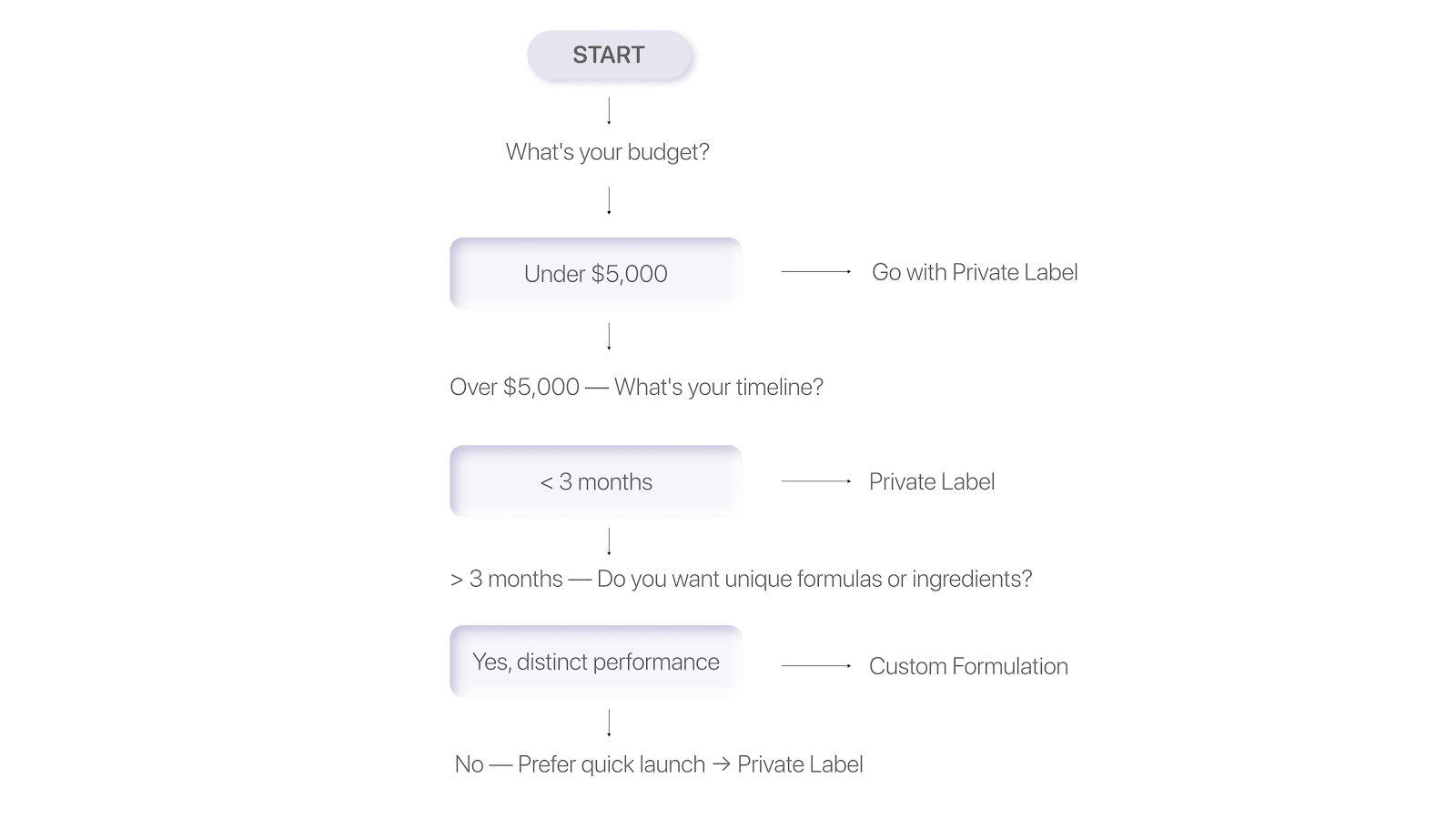
how budget, timeline, and need for differentiation determine whether to go Private Label or Custom Formulation

FOR GD: Add a visual decision flowchart here showing how budget, timeline, and need for differentiation determine whether to go Private Label or Custom Formulation

Text Mockup (for reference):

                START

                  ↓

         What's your budget?

         ┌───────────────┐

         │  Under $5,000 │──────→ Go with Private Label

         └───────────────┘

                  │

                  ▼

       Over $5,000 — What's your timeline?

         ┌───────────────┐

         │  < 3 months   │──────→ Private Label

         └───────────────┘

                  │

                  ▼

        > 3 months — Do you want unique formulas or ingredients?

         ┌────────────────────────────┐

         │ Yes, distinct performance  │────→ Custom Formulation

         └────────────────────────────┘

                  │

                  ▼

         No — Prefer quick launch → Private Label

Now comes the stage where your vision begins to take shape. This is where creativity meets science, and your product begins to come alive.
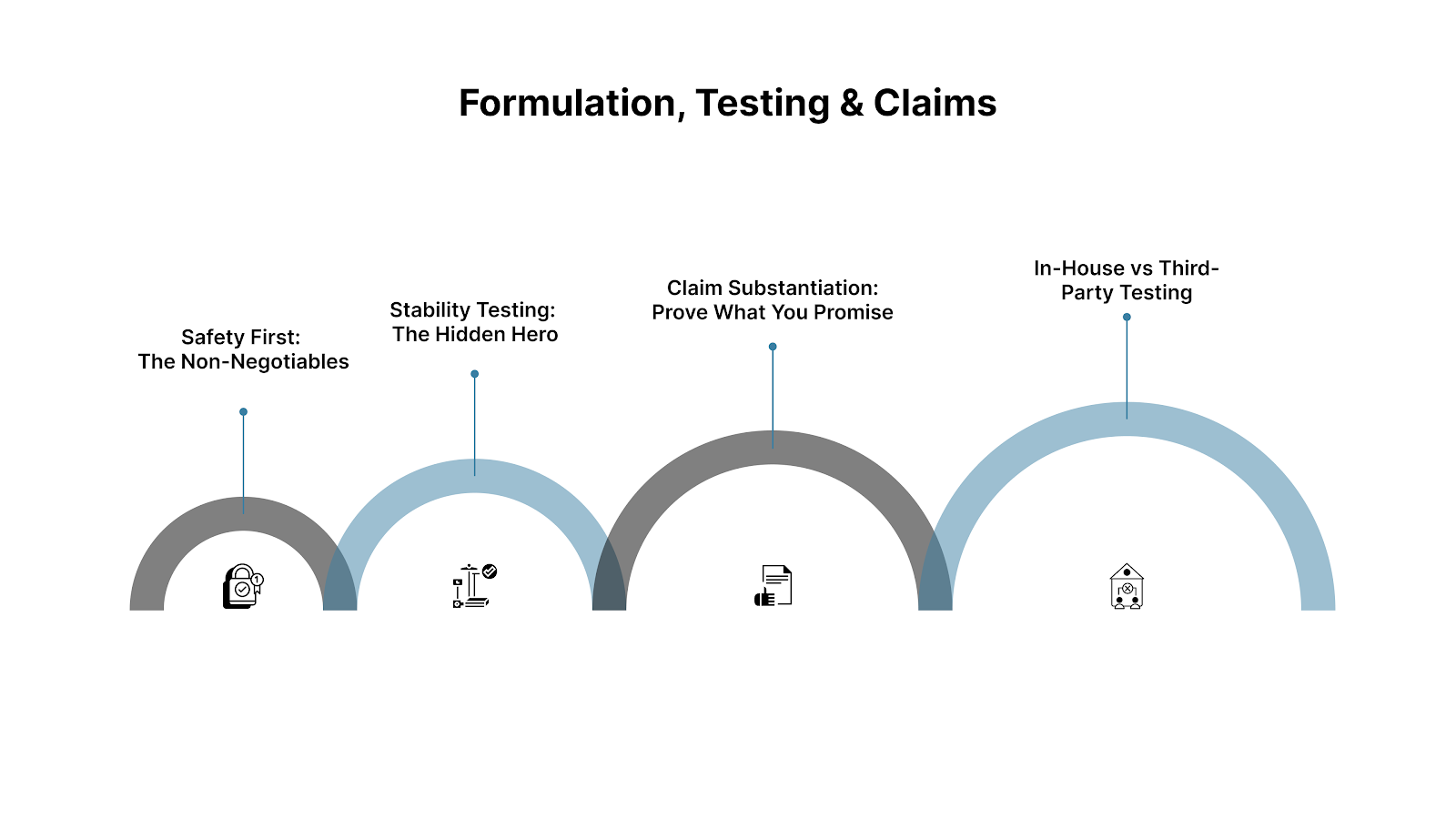
Formulation, Testing & Claims

Formulation, Testing & Claims

Now is where your concept begins to take physical form; a place where creativity meets chemistry, and where every small decision affects your product’s safety, shelf life, and credibility. A brilliant formula means nothing if it can’t stay stable, safe, or legally defensible.

1. Safety First: The Non-Negotiables

Before anything goes into a jar or bottle, every ingredient must be validated.

  • Ingredient Safety Review: Check every raw material against FDA cosmetic regulations and Cosmetic Ingredient Review (CIR) safety assessments to confirm approved usage levels. Use PCPC resources and FDA warning letters to avoid restricted or high-risk ingredients.
  • Preservative Systems: Any water-based product must have an effective preservative system. Poor preservation is a top cause of recalls and contamination.
  • Microbial Testing: Essential for confirming your preservative works. Labs typically charge $100–$500 per sample for bacterial, yeast, and mold tests.

2. Stability Testing: The Hidden Hero

Your product’s shelf life and texture depend on stability. Even minor formulation tweaks can alter how ingredients behave over time.

  • Accelerated Testing: Simulates long-term storage by exposing samples to heat, light, and humidity for weeks. Helps detect separation, oxidation, or microbial growth early.
  • Real-Time Testing: Tracks product performance across months under normal conditions; the gold standard for labeling shelf life.

Skipping these tests is like launching food without a best-before date; it's risky for consumers and your brand.

3. Claim Substantiation: Prove What You Promise

Today, transparency and proof are as crucial as packaging. Here’s what the central claims really require:

  • “Dermatologist-Tested” → Verified documentation showing study design, sample size, and signed results from a certified professional.
  • “Clinically Proven” → Backed by measurable results through clinical or consumer studies with statistical evidence.
  • “Non-Comedogenic” / “Hypoallergenic” → Needs structured testing or published scientific support validating that ingredients don’t clog pores or trigger allergies.

4. In-House vs Third-Party Testing

  • Third-Party Labs: Provide accredited reports recognized by regulators and retailers. Expect longer timelines (4–12 weeks) and higher cost, but stronger credibility.
  • In-House Testing: Faster, cheaper, and good for early-stage quality control, but not sufficient for product launch or claim validation.

With your product scientifically sound and ready to shine, the next challenge is in the paperwork and policies that keep your brand compliant and credible.

Regulatory & Legal Essentials

When your formula’s ready to hit the shelves, the real game begins: compliance. The legal groundwork decides whether your product thrives or vanishes. Here’s what every brand needs to lock in before launch:

  • Product Classification: Know if it’s a cosmetic or a drug. Claims like “treats acne” or “stimulates hair growth” make it a drug under FDA law, requiring approvals. Keep copy benefit-focused, not therapeutic.
  • Labelling Requirements: Follow the FD&C Act and FPLA. Include product identity, net contents, full INCI ingredient list, business details, and warnings. Always use accurate INCI names.
  • Good Manufacturing Practices (GMP): Adopt ISO 22716-style cosmetic GMPs; supplier checks, batch records, expiry dating, QA sign-offs. Retailers expect this even if not legally enforced.
  • Claims Substantiation: Back every claim (“dermatologist-tested,” “clinically proven”) with real data; consumer studies, lab tests, or literature. Keep a “claims dossier” for every SKU.
  • Ingredient Compliance: Verify ingredients against the FDA’s color additive and restricted lists early. Cross-check by market if you plan to sell internationally.
  • Insurance & Recalls: Get product liability insurance, create a recall SOP, and maintain a complaint log. Monitor FDA warning letters for enforcement patterns.

Once your brand is legally sound, it’s time to move from paperwork to production: sourcing, batching, and building what customers will actually hold.

Sourcing, Manufacturing & MOQs

Every great skincare line begins long before the first jar is filled, in the quiet decisions about where your ingredients come from, who crafts your formula, and how many you dare to make first.

These choices set the tone for everything that follows.

1. Sourcing: Building from the Ground Up

Your product is only as good as its ingredients. Ethical and traceable sourcing is your brand’s first quality signal.

  • Work with suppliers who provide Certificates of Analysis (CoAs) and ingredient transparency, ensuring every raw material aligns with your safety and brand promise.
  • Shortlist vendors who specialize in skincare-grade actives, preservatives, and emulsifiers that are FDA-accepted and compliant with your target markets.
  • For packaging, choose recyclable or refillable materials early on, as sustainable design choices can influence both brand story and shipping efficiency.

2. Manufacturing: Partner Smart, Not Solo

Instead of managing multiple vendors and production variables, many emerging brands now choose turnkey manufacturers; partners who handle formulation, testing, packaging, and production under one roof.

Respect Manufacturing is a strong example. Based in the U.S., their FDA-registered, CGMP-compliant facilities deliver full-service skincare manufacturing, from formulation and batching to filling, labelling, and packaging.

Each batch undergoes AQL testing, stability checks, and ingredient verification to ensure consistency and safety.

This approach eliminates coordination chaos and shortens launch timelines, letting you focus on brand-building instead of operational firefighting.

3. MOQs: Start Smart, Scale Strategically

Your Minimum Order Quantity (MOQ) determines how much you’ll produce in your first run, and how much capital you’ll lock up in inventory. Rather than overcommitting, start small to validate demand. Many manufacturers, including turnkey ones like Respect, offer flexible MOQs for pilot runs before scaling.

As you plan, map out:

  • Budget per SKU: Include formulation, packaging, testing, and shipping.
  • MOQ per variant: Start lean — focus on your hero product first.
  • Lead times: Expect 8–12 weeks from final formula approval to production, depending on component availability.

A thoughtful sourcing and production strategy doesn’t just save money, it builds reliability into your brand.

Brand, Positioning & Packaging Design

Your brand is the lens customers use to read every ingredient and claim; make it specific, not generic.

Choose one clear hero benefit (performance, simplicity, or sustainability), build a visual and verbal language around that promise. Then let packaging do the heavy lifting: attractive, functional packaging increases purchase intent and communicates quality at the shelf and online.

Research shows that packaging visual elements strongly influence buying decisions, and sustainability claims can raise willingness to pay.

Once your brand story and packaging speak clearly, the next question is simple: can your numbers back it up?

Pricing & Unit Economics

Great branding means little if your numbers don’t make sense. The smartest founders price backward, starting with costs to ensure every unit sold actually sustains the business.

Here’s how to structure it:

Step What It Covers Why It Matters
1. Calculate COGS Include formula, packaging, testing, filling, and logistics. Defines your baseline: what each product truly costs to make.
2. Add Channel Margins Account for DTC, retail, or marketplace markups. Each channel erodes margin differently — plan before you scale.
3. Factor in CAC Include customer acquisition cost (ads, influencers, samples). Ensures your marketing spend doesn’t eat into profit.
4. Set MSRP Price backward from desired gross margin (typically 60–80% DTC, 50–60% retail). Keeps your pricing sustainable across channels.
5. Test Profitability Use a simple model: COGS → Contribution Margin → CAC → LTV. Validates long-term scalability before your first batch.

Pro Tip: Before finalizing your price, run a few “what-if” scenarios. What happens if ad costs double, or if packaging upgrades by 10%? A pricing model that holds up under pressure lasts.

With your pricing and margins mapped out, it’s time to shift from planning to presence, building the momentum that takes your skincare line from lab to launch.

GTM (Go-to-Market): Pre-Launch & Launch Strategy

Your go-to-market plan determines whether your skincare line enters quietly or arrives with impact. In beauty, visibility is currency, and building that starts long before launch day.

GTM (Go-to-Market): Pre-Launch & Launch Strategy

1. Pre-Launch:

  • Define your audience early. Use social listening on TikTok, Reddit, and Instagram to understand language, aesthetics, and pain points.
  • Create a content runway. Share behind-the-scenes formulation clips, packaging polls, and founder stories to seed curiosity.
  • Build a waitlist. Use landing pages or email signups with incentives (early access, samples, or founder notes).
  • Activate micro-influencers. Focus on niche creators (1K–10K followers) with high engagement; they humanize your story better than big names early on.

2. Launch:

  • Anchor your launch story. What makes your product necessary now? Tie your messaging to a specific outcome (e.g., “barrier repair” or “5-minute skincare”).
  • Leverage owned and earned media. Combine direct channels (email, social, your site) with beauty editors, newsletters, and skincare communities for credibility.
  • Bundle and sample. Intro kits or minis reduce purchase hesitation and increase AOV (average order value).
  • Retarget quickly. Track pre-launch signups and page visitors. Re-engage with launch offers or testimonials within the first two weeks.

3. Post-Launch:

  • Collect user-generated content (UGC) from first customers; before-and-after shots, routines, or unboxing moments drive authentic trust.
  • Monitor reviews and repeat rates closely to refine SKUs and packaging.
  • Use email drip campaigns to re-engage first-time buyers and convert one-time orders into recurring purchases.

However, even the sharpest GTM can stumble without caution; this is where most founders slip.

Common Pitfalls & How to Avoid Them

Every beauty startup stumbles somewhere, but it’s rarely where they expect. Below's where founders most often trip, and what to do before it costs you momentum.

Common Pitfall How to Avoid
Starting with Branding Before Product-Market Fit Validate texture, performance, and sensory cues before you invest in fancy packaging.
Over-Customising Formulas Too Early Begin with tested bases or white-label pilots to avoid 6–12 month R&D delays.
Confusing Aesthetic Consistency with Brand Strategy Your color palette isn’t your positioning; clarity on why you exist beats visual polish.
Underestimating MOQ Cash Lock-In Simulate the cash flow impact of minimum runs; negotiate staggered fulfilments.
Chasing DTC Cool Before Building Retail Discipline Test pricing, replenishment, and returns through small offline pilots first.
Ignoring Regulatory Nuances in Labelling Have your copy and claims checked before printing; relabelling kills margins.
Hiring Influencers Before You Have a Repeatable Conversion Path Build organic demand proof before paid amplification.

Conclusion

The truth is, every skincare founder starts with curiosity; that quiet obsession over textures, scents, and results. However, what separates a fleeting idea from a lasting brand is how you translate that curiosity into consistency.

The beauty business rewards those who move with both precision and patience; testing, iterating, and learning faster than they fail.

That’s where the right partner changes everything. Respect Manufacturing doesn’t just fill bottles; they build systems that make your growth predictable, from sourcing ingredients that match your promise to batching and testing that withstand scrutiny.

Get your custom quote and begin the journey from “idea” to “impact.”

FAQs

1. How much does it cost to start a skincare line in the U.S.?

Most indie skincare founders start with $5,000–$25,000, depending on formulation type, packaging, and batch size. Private label is cheaper to start; custom formulation costs more but builds long-term brand equity.

2. Do I need FDA approval to sell skincare products?

No pre-approval is required for cosmetics, but you must comply with FDA labelling, safety, and GMP guidelines. If your product makes drug-like claims (e.g., “treats acne”), it may be subject to FDA drug regulations.

3. What’s the ideal first product for a new skincare brand?

Start with a hero product: one formula that solves a real problem or aligns with your brand story (like a gentle cleanser or barrier serum). Validate demand before expanding your line.

4. How do I find a trustworthy skincare manufacturer?

Look for FDA-registered, CGMP-compliant manufacturers with transparent sourcing and flexible MOQs. Partners like Respect Manufacturing handle formulation, packaging, and production under one roof.
Get in touch
Thank you! Your submission has been received!
Oops! Something went wrong while submitting the form.
Trusted by 100+ Growth Leaders.

Related blogs

How To Start Your Own Hair Product Line In The USA: A Complete Operational Guide For 2026
8 min read

How To Start Your Own Hair Product Line In The USA: A Complete Operational Guide For 2026

How to start your own hair product line in the USA with a step-by-step operational guide covering R&D, MoCRA compliance, packaging, and turnkey manufacturing.

Learn more
FDA Food Packaging and Labeling Guidelines
8 min read

FDA Food Packaging and Labeling Guidelines

Explore FDA packaging labeling requirements for food, including ingredient declarations, allergen labeling, and compliance strategies to meet FDA standards.

Learn more
35+ Private Label Products You Can Sell in 2026
8 min read

35+ Private Label Products You Can Sell in 2026

Build your brand faster with private label products. Learn how they work, top product types to sell, and common challenges to watch out for.

Learn more