Top Private Label Retinol Skin Care Manufacturers In 2026: A Procurement Guide

Discover the top private label retinol manufacturers for 2026. Learn key selection criteria, sourcing risks, and how to choose the right partner for compliance.

Published on:
β€’
November 29, 2025
Top Private Label Retinol Skin Care Manufacturers In 2026: A Procurement Guide

ON THIS PAGE

Securing a consistent, high-potency retinol supply demands technical due diligence. With the global retinol market projected to reach approximately $1.79 billion by 2030, reflecting a substantial and sustained growth trajectory, according to Grand View Research.

‍

We know retinol projects can be daunting, particularly for new brands juggling timelines, quality expectations, and compliance.

‍

For procurement managers and brand owners, this growth is a clear signal: partnering with a reliable retinol manufacturer is critical to securing a competitive edge and ensuring supply chain stability.

‍

The complexities of working with Vitamin A derivatives, such as Retinol and its gentler counterparts, retinyl palmitate and retinaldehyde, require manufacturing expertise beyond general cosmetics.

‍

In this article, we understand the key criteria for selecting a leading retinol skincare manufacturer in 2026, focusing on their impact on your operational KPIs, and identify manufacturers demonstrating the capabilities needed for high-performance retinol product lines.

‍

Key Takeaways

  • Look for labs that stabilize retinol with advanced techniques and packaging to reduce scrap and protect product strength.
  • Choose partners who source Vitamin A from multiple suppliers to avoid delays and supply disruptions.
  • Work with manufacturers that follow strong quality standards and verify product potency through the full shelf life.
  • Match the manufacturer’s capacity and minimum order sizes to your growth plan, not just the lowest cost.

‍

Key Stages in Retinol Manufacturing

Manufacturing effective retinol products is a specialized process that controls for sensitivity at every stage. This complex workflow directly affects yield improvement and scrap rate.

Aspects Operational Focus KPI Impact
Active Ingredient Handling Handling raw retinol (API) requires temperature and light control, often under an inert atmosphere (e.g., nitrogen blanketing). Reduces API Waste; minimizes Scrap Rate due to pre-formulation degradation.
Stabilization Techniques The necessity of advanced delivery systems (e.g., liposomal, polymer encapsulation) to protect the retinol molecule during and after formulation. Improves yield in the final batch; extends Shelf Life efficacy.
Specialized Equipment The need for specialized mixers and closed-loop filling lines to prevent oxygen exposure during bottling. Increases Equipment Uptime by using validated systems; protects Product Integrity.

Note: For US launches, refer to FDA Cosmetic Labeling Requirements Guide to ensure ingredient listings, claims, and retinol concentrations align with current cosmetic regulations.

‍

How to Gage Retinol Manufacturers in 2026

‍

Choosing the right retinol manufacturer is not about finding the cheapest quote; it’s about mitigating supplier risk and securing product integrity. We understand the pressure to maintain high product efficacy while controlling costs. Your selection process should directly address the following:

  • Equipment uptime
  • Scrap rate and yield
  • Lead time stability
  • Supplier risk and regulatory exposure
  • Cost per unit over the product life cycle

‍

1. Formulation and Stability Expertise

Retinol degrades quickly under heat, light, and oxygen. Choose partners that use encapsulation, offer multiple retinoids, and test packaging for compatibility. This helps cut scrap, improve yield, and keep scale-ups predictable.

‍

2. Quality, Compliance, and Documentation

Compliance goes beyond regulatory requirements by directly reducing production downtime, minimizing rework through standardized procedures, and lowering the risk of product holds due to non-conformance.

Compliance Checklist (Minimum Requirement) Operational Impact (KPI Focus)
GMP Certified (ISO 22716 or Equivalent) Reduces production downtime from non-conformance issues.
Strong Change Control SOPs Maintains lead time stability by managing raw material or process changes transparently.
Batch-Specific COAs and Traceability Reduces supplier risk by providing full visibility from raw ingredients to finished products.
Stability Testing Protocols Ensures product efficacy over the stated shelf life, protecting brand equity.

Note: These translate to more predictable lead times, less time lost to corrective actions, and lower exposure to recalls or reformulations.

‍

3. Operational Capabilities and Scale

Even the best formula will not help if the plant cannot support your volumes.

‍

Look for:

  • MOQ options that match your stage: stock formulas and private label for pilots, custom OEM once demand is proven
  • Clear process to move from pilot batches to full commercial runs
  • Transparent communication on current capacity and scheduling, especially during peak periods

‍

Note: Cost considerations vary widely depending on minimum order quantities, formulation complexity, and packaging options. While price should not be the primary selection factor, understanding typical cost ranges helps in budgeting and supplier evaluation.

‍

Once you confirm capability, focus on hidden risks, sourcing issues, and stability issues that affect scrap rate, yield, and lead time. Retinol makes these risks higher than most skincare actives.

‍

Sourcing and Operational Risks for Retinol Products

Retinol projects face specific risks that can hurt cost per unit and launch timelines if not managed early.

Risk Area Why It Matters (Operational Impact) What to Check / Mitigate
Raw Material Purity & Sourcing
  • A concentrated Vitamin A supply chain raises price and lead-time exposure.
  • Greater chance of out-of-spec batches.
  • Direct impact on cost per unit, yield, and lead time stability.
  • Manufacturers should qualify multiple API suppliers.
  • Require batch-specific COAs.
  • Confirm temperature-controlled storage for retinol and derivatives.
Packaging Compatibility
  • Wrong packaging accelerates oxidation.
  • Causes early discoloration/odor shifts.
  • Leads to scrap, returns, and line adjustments.
  • Use opaque / UV protective packaging.
  • Prefer airless pumps or tight-seal tubes.
  • Ensure components are validated on filling lines to avoid downtime.
Regulatory Compliance for Concentrations
  • Varying rules across the EU, US, and APAC.
  • Mislabelled or non-compliant SKUs cause launch delays and reformulation cycles.
  • Work with partners with in-house regulatory teams.
  • Confirm expertise in regional max retinol limits.
  • Ensure support for Safety Data Sheets (SDS), PIF, and label review.

Building a retinol line can be complex. Respect Manufacturing simplifies testing and compliance so you can focus on product development while we manage potency, safety, and regulatory requirements. Contact Now.

‍

Comparison of Key Private Label Retinol Manufacturers in 2026

Selecting a retinol partner means evaluating their expertise with unstable actives. Below is a breakdown of manufacturers with proven capabilities, grouped by their operational strengths.

‍

Private Label Retinol Manufacturers

Manufacturer Location Focus Specialisation Focus Typical Fit by Volume/Stage
Respect Manufacturing US and Canada focus Dietary supplements, skincare, and personal care, turnkey CGMP Small to scaling brands needing a single partner
Selfnamed US and EU fulfilment Dropshipping, vegan, and clean beauty stock formulas Very low volume, test launches, D2C brands
Trilogy Laboratories US, professional channel Medical-grade skincare, high active levels Small to mid volume, pro and clinic brands
Pravada Private Label US-focused Clean beauty, encapsulated and time-released retinol Low to mid-volume, premium retail and spa
Prime Matter Labs US, national, and global Advanced OTC, cosmeceutical, complex delivery systems Mid- to high-volume, innovation-focused brands
Medpak Solutions US Full-service cosmetic and personal care manufacturing Mid to high volume custom projects
Rainshadow Labs US and bulk export Natural and organic, large bulk volumes High-volume, in-house filling or bulk buyers
Pure Source, LLC US Turnkey personal care and OTC, regulatory-heavy projects High-volume, regulated, or OTC-oriented lines

Also Read: How to Start a Skincare Line in 2025
‍

1. Respect Manufacturing

Respect Manufacturing

Respect Manufacturing is a CGMP-focused contract manufacturer that works across dietary supplements, skincare, and personal care. They emphasize quality, transparency, and traceability for wellness and beauty brands.

‍

Formulation and packaging capabilities

  • Provides R&D and formulation services for new products and refinement of existing ones, including skincare lines that feature retinol or supporting actives.
  • Supports multiple packaging formats, such as bottles, jars, tubes, stickpacks, and sachets, along with secondary packaging like labels and cartons.
  • Manages stability testing so that formulations maintain their performance over the expected shelf life.

‍

Operational fit: Ideal for fast-growing brands wanting a single CGMP partner to handle formulation, manufacturing, packaging, and consistent quality across multiple SKUs.

‍

Why beginners choose Respect Manufacturing

Beginner brands choose Respect Manufacturing to simplify R&D, manufacturing, and packaging under one partner while keeping clear visibility into quality and documentation.
‍

2. Selfnamed

Selfnamed

Selfnamed operates with fulfillment coverage in the United States and the European Union and focuses on private label skincare that is often vegan, cruelty-free, and aligned with clean beauty positioning.

‍

Formulation and packaging capabilities

  • Large catalog of ready-to-brand skincare formulas, including serums, creams, and masks.
  • Built-in branding and packaging options, suitable for D2C storefronts.
  • Integrations that connect with popular e-commerce platforms and support drop shipping or just-in-time supply.

‍

Operational fit: Best for very low-volume brands that need fast launches, flexible MOQs, and minimal inventory risk.

‍

Why beginners choose Selfnamed

New founders often pick Selfnamed because they can start with a handful of units, validate demand, then scale up without changing manufacturers immediately.
3. Trilogy Laboratories

Trilogy Laboratories

Trilogy Laboratories is based in Fort Myers, Florida, and focuses on medical-grade skincare that serves dermatology clinics, medspas, and professional esthetics brands.

‍

Formulation and packaging capabilities

  • Strong portfolio of highly active serums, including retinol- and peptide-rich formulas.
  • The facility operated to GMP and cosmetic quality standards, suitable for pro channel expectations.
  • Emphasis on post-procedure and sensitive skin products, which is important for retinol tolerance.

‍

Operational fit: It is ideal for professional and clinic channels that require highly active formulas with consistent batch performance.

‍

Why beginners choose Trilogy Laboratories

New professional brands choose Trilogy because they get science-driven formulations and a partner used to clinical expectations, without managing complex R&D on their own.
‍

4. Pravada Private Label

Pravada Private Label

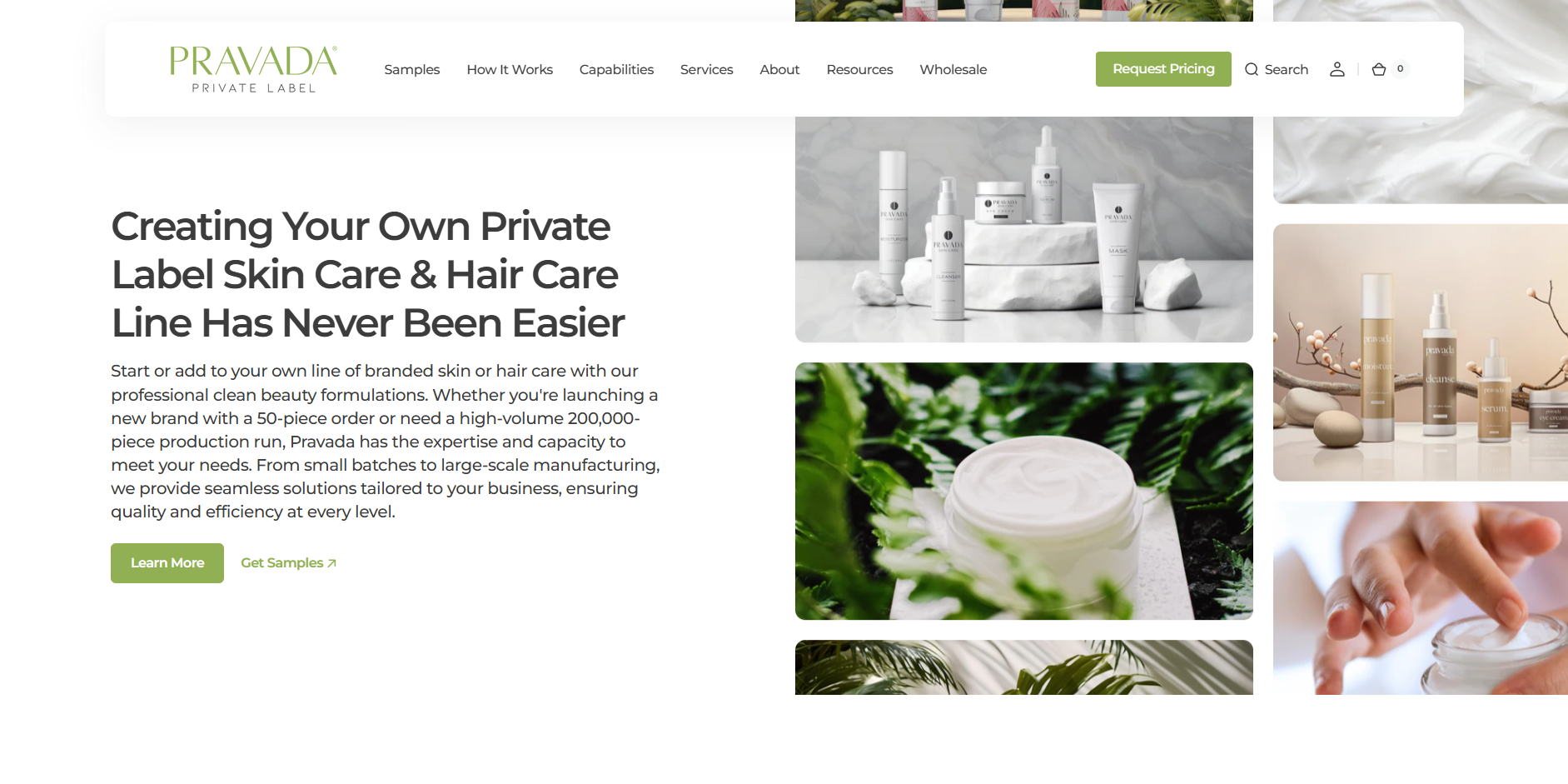
Pravada Private Label operates in the United States and targets brands that want clean beauty formulations with advanced delivery systems, such as encapsulated retinol.

‍

Formulation and packaging capabilities

  • Broad range of stock formulas, many aligned with natural or clean label expectations.
  • Offers encapsulated and time-released retinol products, useful where stability and gentler delivery are priorities.
  • Standard private label model where you can customize packaging, fragrance, and branding while keeping the base formula.

‍

Operational fit: Suited for premium brands needing encapsulated retinol and low to mid MOQs without sacrificing formulation quality.

‍

Why beginners choose Pravada

Beginner brands often choose Pravada because they can launch encapsulated retinol products with modest starting quantities, which lowers risk while still offering a technically advanced active.

‍

5. Prime Matter Labs

Prime Matter Labs

Prime Matter Labs has facilities in key US hubs and works with national and global brands. They specialize in advanced OTC, cosmeceutical, and complex delivery systems.

‍

Formulation and packaging capabilities

  • Expertise in bag-on-valve, anhydrous systems, and sun plus skin hybrid products.
  • Internal support for stability testing and SPF testing, useful for brands that want multi-active, high-performance lines.
  • Strong project management and digital tracking of development and production status.

‍

Operational fit: Right for innovation-driven brands that need advanced delivery systems, strong documentation, and scalable production.

‍

Why beginners choose Prime Matter Labs

New but well-funded brands choose Prime Matter Labs when they plan for rapid scaling and need a partner that can handle more complex packaging and regulatory needs from day one.
‍

6. Medpak Solutions

Medpak Solutions

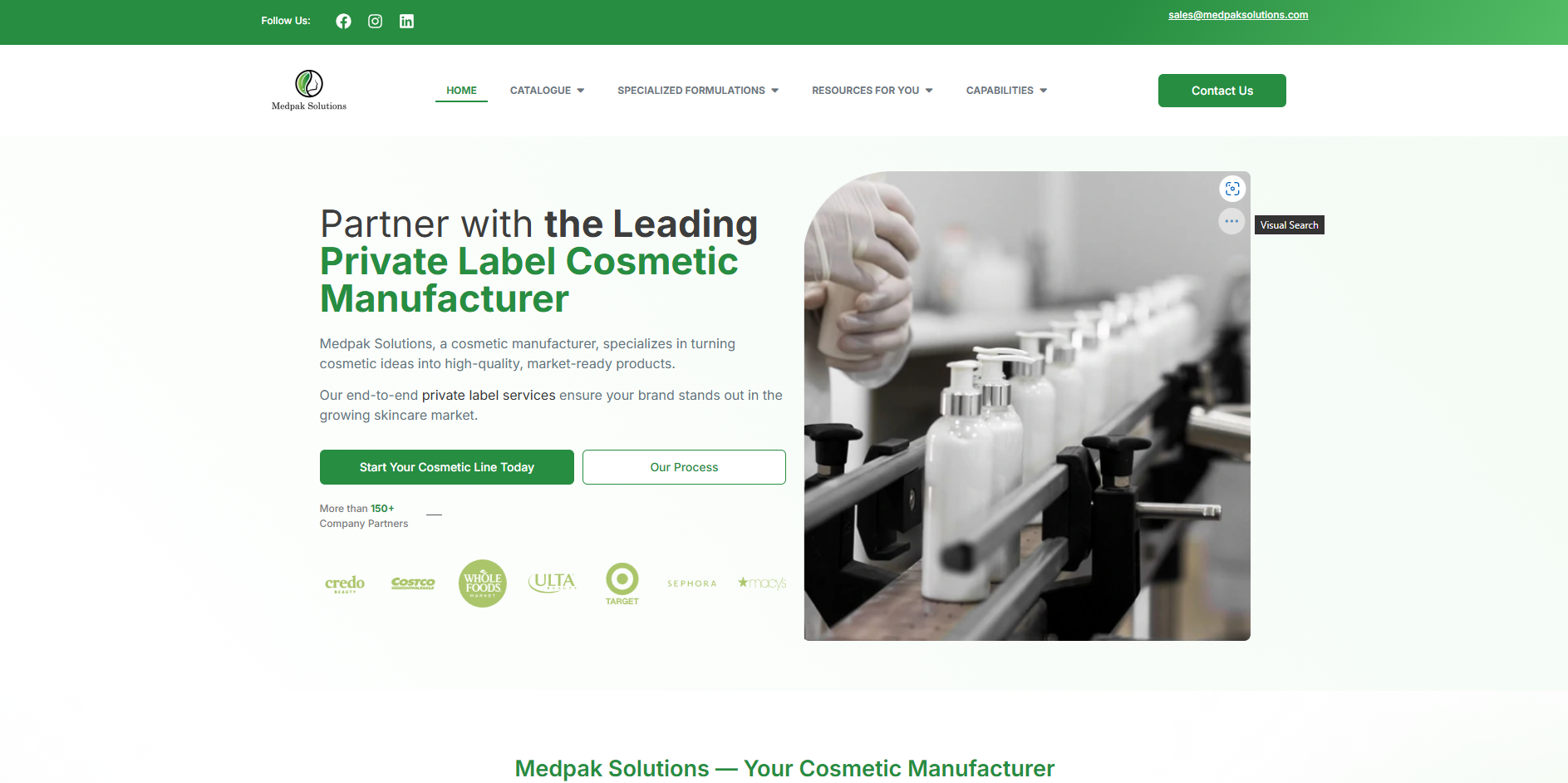
Medpak Solutions is a US-based manufacturer that offers full-service cosmetic production, including skincare and personal care products.

‍

Formulation and packaging capabilities

  • Handles creams, lotions, gels, and various pack formats such as tubes, jars, sachets, and selected aerosol work.
  • Offers turnkey services, from formulation and packaging sourcing to filling and quality checks.
  • Capacity that can support growing mid to high volume brands.

‍

Operational fit: Best for brands preparing for larger production runs and needing turnkey support across formulation, filling, and packaging.

‍

Why beginners choose Medpak Solutions

Brands moving toward retail choose Medpak for higher volumes and reliable guidance on packaging and compliance.
‍

7. Rainshadow Labs

Rainshadow Labs

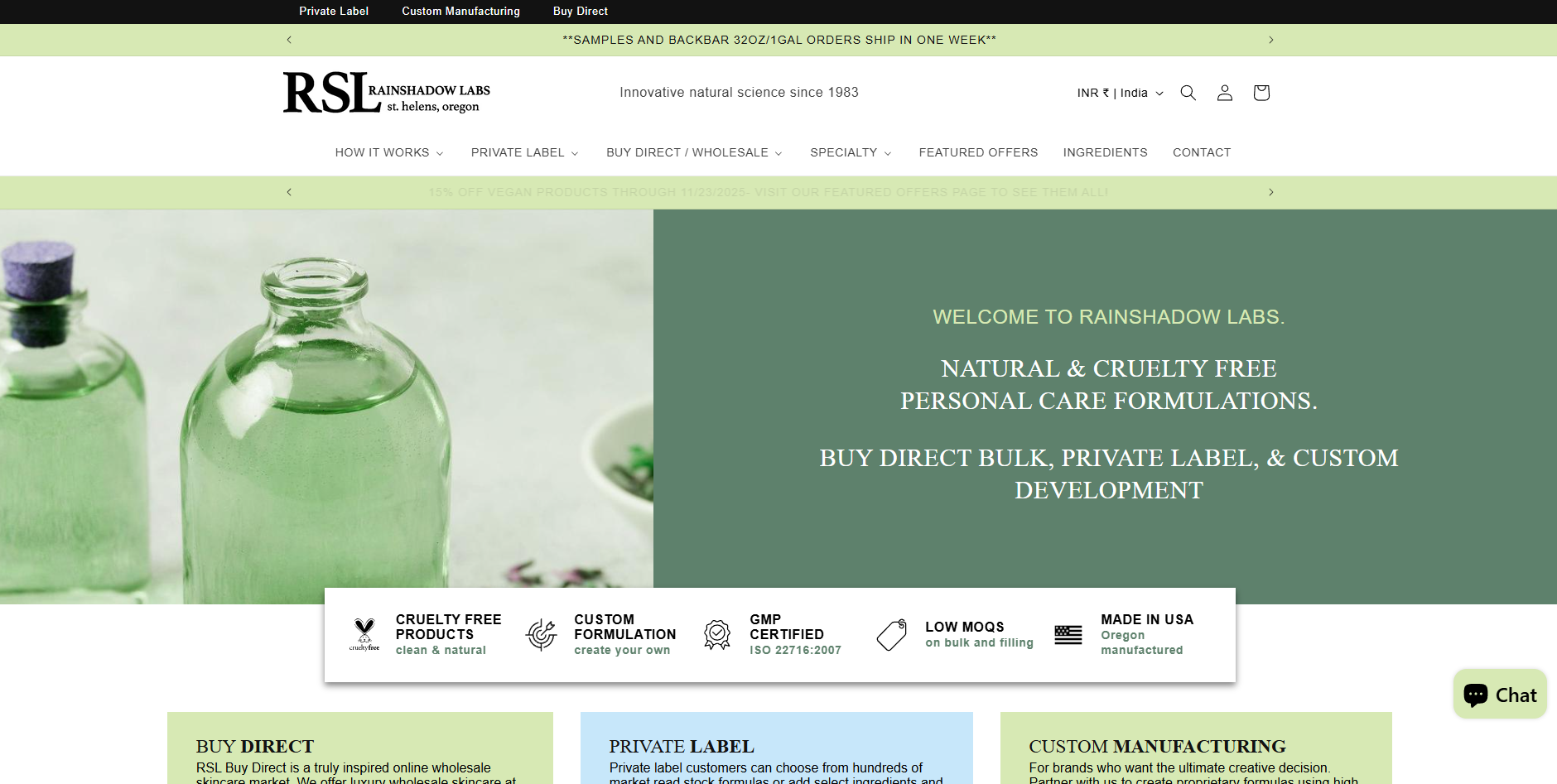
Rainshadow Labs is located in St. Helens, Oregon, and focuses on natural and organic skincare in bulk and private label formats.

‍

Formulation and packaging capabilities

  • Large range of bulk base formulas, including serums, lotions, and oils that align with organic and natural claims.
  • A facility that emphasizes green practices, suited to brands that care about sustainability positioning.
  • Bulk sizes, often from back bar volumes up to multi-gallon containers, for brands that fill in-house or use a secondary packer.

‍

Operational fit: Fits brands buying bulk volumes or managing in-house filling, especially those focused on natural/organic lines.

‍

Why beginners choose Rainshadow Labs

Newer brands with strong in-house operations or contract fillers choose Rainshadow because they can source organic-aligned bases in volume, then customize and package under their own control.
‍

8. Pure Source, LLC

Pure Source

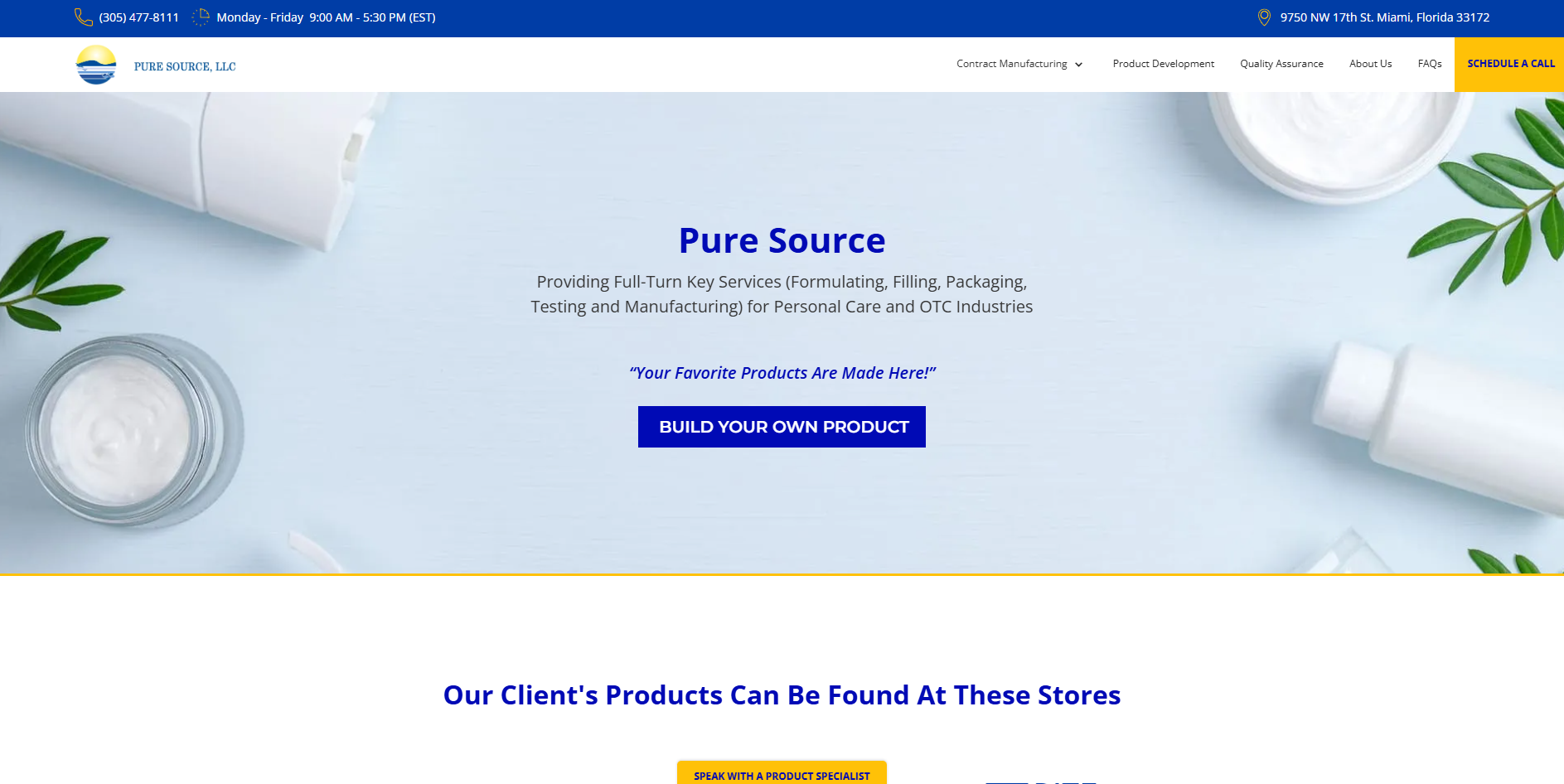
Pure Source, LLC is based in Miami, Florida, and offers turnkey personal care and OTC contract manufacturing, including products that need closer regulatory attention.

‍

Formulation and packaging capabilities

  • Ability to produce creams, gels, lotions, sticks, and certain patches or targeted delivery formats.
  • Experience with OTC classifications, such as acne products or sun care, which can overlap with retinoid-based projects.
  • Strong focus on regulatory documentation and inspections.

‍

Operational fit: Strong match for established brands needing high-volume runs and OTC-level regulatory oversight.

‍

Why beginners choose Pure Source

Beginners choose Pure Source when they enter regulated or quasi-regulated categories early and want a partner that can guide them through documentation, registration, and quality audits.

‍

The comparison shows which partners fit your needs. Now you need a shortlisting process that tracks scrap risk, lead time stability, and overall operational fit.

‍

How to Shortlist and Engage Retinol Manufacturers

A few practical steps help align your shortlist with your KPIs.

‍

  1. Define product scope clearly.
    • Retinol percentage range
    • Market regions and regulatory level (cosmetic only, or any OTC overlap)
    • Packaging type and positioning (clinical, spa, mass retail, D2C)
  2. Segment manufacturers by stage and volume
    • Very low volume and test stage: Selfnamed, Pravada
    • Professional or clinic channels: Trilogy Laboratories
    • Innovation-heavy and scaling: Prime Matter Labs, Pure Source
    • Bulk and organic: Rainshadow Labs
    • Turnkey multi-category partner: Respect Manufacturing, Medpak Solutions
  3. Ask KPI driven questions in RFQs
    • How do you manage retinol stability, and what tests do you perform before release
    • What is your approach to multi-sourcing Vitamin A APIs
    • How do you handle change control for key raw materials
    • What is your typical range of MOQs for stock formulas and customs
  4. Pilot with measurable criteria
    • Track scrap rate, batch release cycle, and deviations during pilot runs
    • Monitor communication responsiveness and documentation quality
    • Use these data points to decide which partner should handle your larger rollouts.

‍

Suggested Read: Contract Manufacturing vs Private Label: What’s the Difference

‍

Conclusion

Retinol should be sourced as a specialized category. Choose partners with proven stability expertise, the right capacity, and regional compliance strength. Early brands need low MOQs and testing support; scaling teams need multi-SKU capability and tighter documentation.

‍

Private-label profitability improves when your manufacturer minimizes scrap, protects product efficacy, and keeps lead times stable, driving better margins and repeat sales.

‍

A turnkey CGMP partner such as Respect Manufacturing helps maintain consistency as your line expands.

‍

If you want a manufacturing partner whose processes strengthen your agreement, connect with Respect Manufacturing today.

‍

FAQs

1. What makes retinol manufacturing more complex than standard skincare?

Retinol is highly unstable, so it needs specialized handling, encapsulation, and protective packaging to avoid scrap and potency loss.

2. What MOQ should I expect for private-label retinol products?

MOQs vary by vendor, some offer low starting quantities for stock formulas, while custom formulas typically require higher runs.

3. How can I reduce stability failures in retinol products?

Choose manufacturers that run full stability testing, validate packaging, and use microencapsulated or time-released retinoids.

4. Do retinol concentrations affect regulatory requirements?

Allowed percentages and label warnings differ across regions, so work with manufacturers familiar with EU, US, and APAC guidelines.
Get in touch
Thank you! Your submission has been received!
Oops! Something went wrong while submitting the form.
Trusted by 100+ Growth Leaders.

Related blogs

How To Start Your Own Hair Product Line In The USA: A Complete Operational Guide For 2026
8 min read

How To Start Your Own Hair Product Line In The USA: A Complete Operational Guide For 2026

How to start your own hair product line in the USA with a step-by-step operational guide covering R&D, MoCRA compliance, packaging, and turnkey manufacturing.

Learn more
FDA Food Packaging and Labeling Guidelines
8 min read

FDA Food Packaging and Labeling Guidelines

Explore FDA packaging labeling requirements for food, including ingredient declarations, allergen labeling, and compliance strategies to meet FDA standards.

Learn more
35+ Private Label Products You Can Sell in 2026
8 min read

35+ Private Label Products You Can Sell in 2026

Build your brand faster with private label products. Learn how they work, top product types to sell, and common challenges to watch out for.

Learn more